


A small air bubble in your cart is almost always normal, not a sign the cartridge is broken. Most bubbles form because cannabis oil is thick and viscous, and they respond well to three quick moves: tap the cartridge gently against your palm, warm it between your hands for some time, then take a short pulse draw rather than a long pull. That combination clears most cart air bubble issues in under a minute.
Before you try anything else, check these signals:
- Airflow: Can you draw air through the mouthpiece at all?
- Flavor: Does it taste clean or burnt?
- Vapor: Is production normal, weak, or absent?
- Leaking: Is oil visible on the outside of the cart or on battery contacts?
If airflow and flavor are fine, the bubble is cosmetic. If you see leaking or taste burning, stop and read the replacement section below.
Safety first: Never use an open flame to warm a cartridge, and never microwave it. Gentle heat only. Carts from sources like Thcvapesuk come with a Certificate of Analysis (COA), which tells you the oil’s terpene content and extraction method — useful context when diagnosing why a bubble behaves the way it does.
Key Takeaways
Small, slow-moving bubbles in a vape cartridge are usually a viscosity characteristic of the oil, not a defect, and most clear up with gentle warmth and short pulse draws.
| Point | Details |
|---|---|
| Bubbles are often normal | Slow or stuck bubbles in live resin carts signal thick, terpene-rich oil, not a fault. |
| Warm and pulse to fix | Gentle hand heat, a low hair dryer, or a preheat function clears most cart air pocket problems. |
| Red flags justify return | Persistent leaks, burnt taste after warming, or no vapor on a working battery mean replace or return. |
| Store upright at room temp | Upright storage at room temperature prevents oil from pooling and reduces new bubble formation. |
| Thcvapesuk offers COA-backed carts | Lab-tested cartridges with published COAs let you verify formulation and predict bubble behavior. |
Table of Contents
- What causes an air bubble in a vape cart?
- How do bubbles actually change your vaping experience?
- How to safely remove air bubbles from a cartridge
- When should you replace or return the cartridge?
- How to store cartridges so bubbles stay manageable
- One-minute checklist to try right now
- Why oil type and temperature explain most bubble behavior
- What experienced vapers actually learn about bubbles
- Lab-tested cartridges reduce the guesswork significantly
- Sources
What causes an air bubble in a vape cart?
Four main factors drive bubble formation, and knowing which one applies to your cart tells you how to fix it.
- Oil viscosity and formulation. Live resin and high-terpene extracts are naturally denser than distillate. Thick oil moves slowly, so air that gets trapped during filling stays trapped longer. A slow or motionless bubble in a live resin cart is often a sign of a full-profile extract, not a defect.
- Temperature swings. Cold thickens oil and makes bubbles look completely stuck. Heat thins oil and lets trapped air escape, but it also expands the oil itself, which can draw a small air pocket in through a loose seal. According to Vessel, temperature-driven expansion and contraction is one of the most common causes of bubbles in vape carts.
- Manufacturing and filling. Every cartridge has intentional headspace — the small gap between the oil surface and the top of the reservoir. Dispensary 33 explains that this headspace, combined with the filling process itself, can trap air if the cart is filled too fast, overfilled, or underfilled. Cartridge geometry and wick position also affect where that air ends up.
- Seal or hardware failure. A cracked housing, loose mouthpiece, or degraded O-ring lets outside air into the reservoir. Unlike the other causes, this one tends to get worse over time and usually shows up alongside leaking.
How do bubbles actually change your vaping experience?
Most of the time, they don’t. A bubble sitting at the top of a full cart, or one that moves slowly when you tilt the cartridge, has no effect on vapor production as long as oil still covers the coil and wick.
The situation changes when a bubble grows large enough to pull oil away from the wick. At that point, the coil heats without enough oil to vaporize, and you get a dry or burnt hit. Weedmaps notes that if the cartridge still produces clean vapor and consistent flavor after a brief warm-up, the bubble is almost certainly a viscosity characteristic rather than a functional fault.
Here’s a quick diagnostic:
- Normal: Bubble present, vapor is consistent, flavor is clean, airflow is open. Warm the cart and continue.
- Viscosity issue: Bubble looks stuck, hits are weak in cold weather but improve after warming. Temperature is the cause.
- Hardware problem: Bubble grows over time, oil appears on the outside of the cart, or flavor is consistently burnt even after warming. The seal or coil may be compromised.
- Thinning additives: Bubble moves unusually fast in a cart labeled as live resin. Weedmaps flags this as a possible sign the oil was cut with additives to improve flow at the cost of terpene retention.
How to safely remove air bubbles from a cartridge
Work through these steps in order, from least to most involved. Most cart air pocket problems resolve at step 2 or 3.
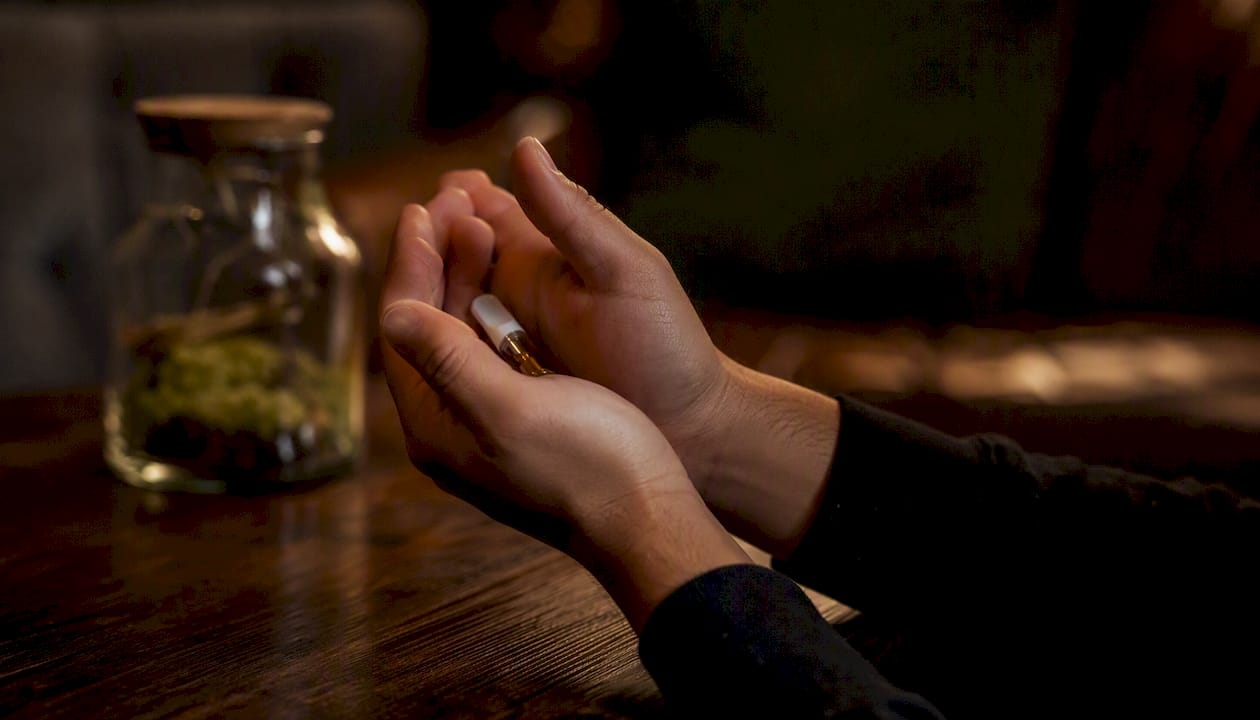
- Tap and roll. Hold the cartridge between your fingers and tap it gently against your palm five or six times. Then roll it slowly between your palms. This dislodges bubbles from the wick and encourages oil to flow back toward the coil.
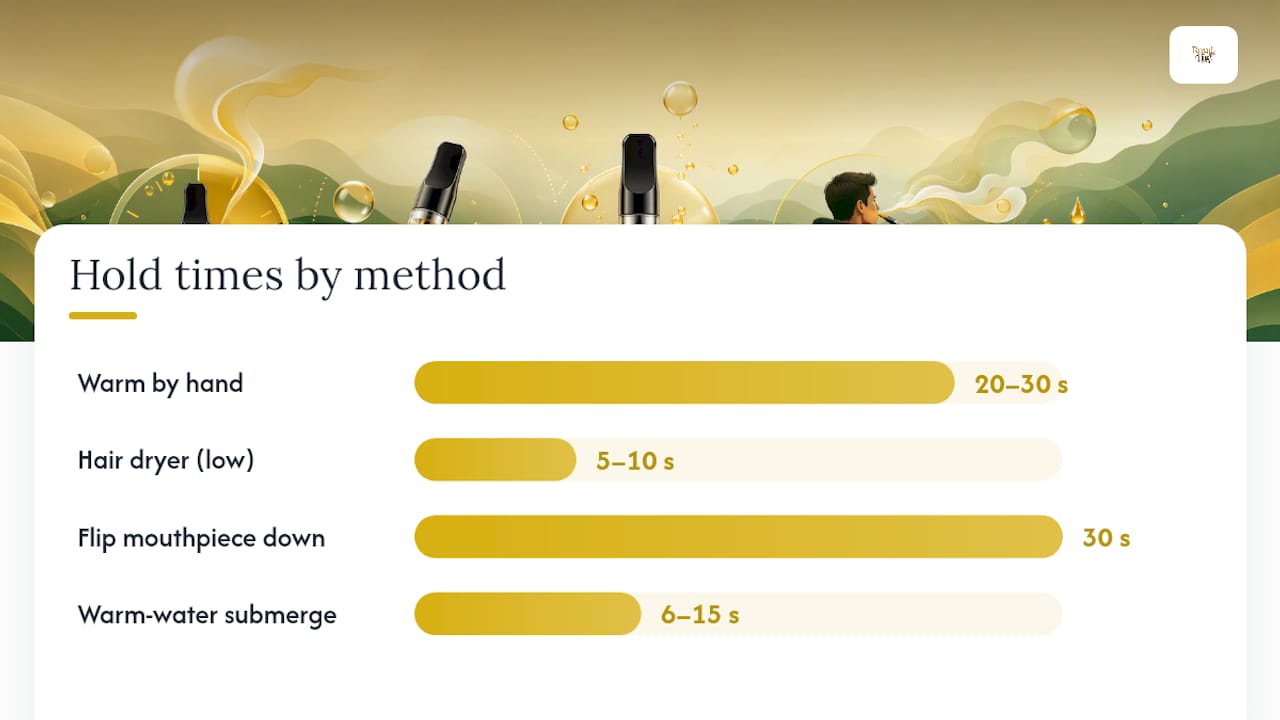
- Warm it by hand. Cup the cartridge in both hands and hold it for 20–30 seconds. Body heat is enough to thin most viscous oils. For a faster result, use a hair dryer on its lowest setting, held at least six inches away, for no more than 5–10 seconds.
- Flip and pulse. Hold the cartridge with the mouthpiece pointing down for 30 seconds. This lets gravity pull oil back toward the coil. Then take two or three short, gentle pulse draws rather than one long pull. Lookah recommends short pulse draws specifically because long pulls can overheat the coil, before thick oil has time to re-saturate the wick.
- Warm-water method. Fill a small cup with warm (not hot) water. Seal the mouthpiece with your thumb, then submerge only the lower body of the cartridge for 6–15 seconds. Keep the mouthpiece completely dry. The gentle warmth thins the oil and lets trapped air rise out. Dry the cart fully before attaching it to a battery.
- Use the preheat function. Many batteries include a preheat mode that fires at low wattage for a few seconds. Activate it once or twice before drawing. This is the cleanest method for viscous live resin carts because it warms the oil evenly without any risk of water contact.
Safety callouts: No open flame, ever. No microwave. Avoid sustained high heat — it degrades terpenes and can damage the coil or housing. If you smell burning at any point, stop immediately.
Pro Tip: Short, pulse-style draws do double duty: they let viscous oil flow back to the wick between hits and preserve terpene flavor better than long, continuous pulls.
When should you replace or return the cartridge?
Some problems don’t respond to warming and tapping, and pushing through them risks a burnt coil or wasted oil. Return or replace the cart when you see any of these:
- Oil is visibly leaking from the cartridge body, mouthpiece, or bottom connection.
- Flavor is consistently burnt even after multiple warming cycles and pulse draws.
- No vapor at all, even after confirming the battery works on a different cart.
- The bubble grows noticeably larger over a day or two without any change in use.
- Visible cracks, a loose mouthpiece, or a damaged O-ring.
Before contacting the seller, run through one more check: try the cartridge on a second, known-working battery. A dead or incompatible battery mimics many of the same symptoms as a defective cart. If the problem persists on a second device, the cart itself is the issue.
When you reach out to the seller, have your order number and a photo of the cartridge ready. Ask specifically for return or replacement instructions and, if the problem seems oil-related, request the COA for that batch. The COA lists terpene percentage and extraction method, which helps confirm whether slow bubble behavior matches the product description. Choosing lab-tested cartridges from the start reduces the chance of running into seal or formulation problems.
How to store cartridges so bubbles stay manageable
Good habits prevent most bubble problems before they start.
- Store upright at room temperature. Keeping the mouthpiece up lets gravity hold oil over the wick and prevents it from pooling at the top or leaking through the mouthpiece.
- Avoid cold storage. A refrigerator or cold car thickens oil dramatically. If a cart has been in the cold, let it return to room temperature before using it.
- Keep it away from direct sunlight and heat sources. UV light and sustained heat degrade terpenes and thin the oil, which can pull air in through seals.
- Avoid chain-hitting. Back-to-back draws heat the coil faster than oil can replenish it. Two or three draws, then a short pause, keeps the wick saturated.
- Travel and altitude. Pressure changes at altitude can cause oil to expand slightly and push small bubbles in through seals. After a flight or a long mountain drive, let the cart sit upright for 15–20 minutes before using it.
- Filling best practices. If you refill carts yourself, fill slowly and avoid trapping air in the reservoir. Slightly underfilling is safer than overfilling, which can block the airflow path.
One-minute checklist to try right now
Run through this before anything else.
- Tap the cartridge gently against your palm five or six times.
- Warm it in your cupped hands for 20–30 seconds, or use a hair dryer on low for 5–10 seconds.
- Flip it mouthpiece-down for a short period, then take two or three short pulse draws.
- Check the outside of the cart and the battery connection for any visible oil or leaking.
- If hits are still weak, try the cart on a different battery or activate the preheat function.
Stop immediately if you smell burning or if oil reaches the battery contacts. Oil on contacts can short the battery and damage both the cart and the device.
Why oil type and temperature explain most bubble behavior
The physics behind bubbles in vape carts comes down to two things: viscosity and gas solubility.
Viscosity determines how fast oil flows. Terpene-rich extracts like live resin and full-spectrum oils are denser than refined distillate, so air trapped during filling moves through them slowly or not at all. Vapemeds notes that slow or stuck bubbles in a live resin cart are often an expected trait of a less-processed, full-profile extract. A bubble that barely moves when you tilt a live resin cart is not a defect. A bubble that races across a cart labeled live resin probably is, since fast movement suggests the oil was thinned with additives.
Gas solubility adds another layer. Henry’s Law/Physical_Properties_of_Matter/Solutions_and_Mixtures/Ideal_Solutions/Dissolving_Gases_In_Liquids%2C_Henry’s_Law) describes how gases dissolved in a liquid come out of solution when pressure drops or temperature rises. In a cartridge, a sudden temperature increase or a drop in ambient pressure (altitude, for example) can cause dissolved gases to form visible bubbles even in a perfectly sealed cart. This is the same principle behind carbonation releasing from a soda when you open the can.
To evaluate a cart’s formulation before you buy:
- Look for a COA that lists terpene percentage alongside cannabinoid content.
- Check the extraction method: live resin, distillate, broad-spectrum, or full-spectrum each behave differently.
- Slow bubbles in a high-terpene product are consistent with the label. Fast bubbles in the same product are worth questioning.
For a deeper look at how distillate and live resin compare in terms of viscosity and bubble behavior, the formulation differences are significant enough to change your troubleshooting approach entirely.
What experienced vapers actually learn about bubbles
The conventional wisdom treats any bubble in a cartridge as a problem to fix. That framing misses something. In a well-made live resin or full-spectrum cart, a slow-moving bubble is closer to a quality indicator than a fault. It means the oil hasn’t been thinned to the point where it flows like water, which usually means terpenes and plant compounds are still intact.
The real skill is learning to read the bubble rather than just reacting to it. A bubble that stays put in cold weather and disappears after warming is telling you the oil is doing exactly what thick, terpene-rich oil does. A bubble that grows, leaks, or refuses to clear after every fix in this guide is telling you something structural is wrong.
COA transparency matters here more than most vapers realize. When you can see the terpene percentage and extraction method on a lab report, you have a reference point for what the oil should look like and how it should behave. Without that, you’re guessing. That’s why sourcing from retailers who publish COAs for every batch isn’t just a safety preference. It’s the only way to know whether a slow bubble is a feature or a flaw.
Lab-tested cartridges reduce the guesswork significantly
Repeated bubble problems, persistent leaks, or inconsistent vapor often trace back to formulation or hardware quality rather than anything the user did wrong. Thcvapesuk carries lab-tested cartridges from brands including Dabwoods, Stiiizy, Muha Meds, Raw Garden, and Packman, each with COA documentation covering cannabinoid and terpene content. That transparency means you can match the bubble behavior you see to what the oil’s composition actually predicts.

If you’re newer to cartridges and want to avoid the trial-and-error phase, the beginner’s guide to a first THC vape session covers device setup, draw technique, and dosing in plain language. For readers who want to compare options by formulation type, the lab-tested cart selection is a practical starting point.
THC products are for adults 21 and over. Check your local laws before purchasing. This article is general information, not legal or medical advice.
Sources
- Why a vape cart bubble won’t move? Here’s why | Weedmaps
- Bubbles in Vape Cart – What Does It Mean? – Vessel
- How to Get Rid of Air Bubbles in Dab Cartridges
- Why are there Air Bubbles in Cartridges? | Dispensary 33
