


For most edible beginners, 2.5 mg THC is the recommended starting dose. If you’re especially cautious or sensitive, drop to 1 mg. This guide is general information, not medical advice. THC possession and supply remain controlled under UK law. See the UK legal section below before purchasing anything. The rule you need to remember before anything else: start low, wait long, increase slowly.
Key Takeaways
The single most important rule for any beginner: 2.5 mg is your edible starting dose, two hours is your minimum wait, and no dose increase happens within the same session.
| Point | Details |
|---|---|
| Start at 2.5 mg or lower | Most edible beginners should start at 2.5 mg; drop to 1 mg if you’re especially cautious. |
| Wait 2 hours before redosing | Edible onset can take up to 2 hours; redosing early is the most common cause of overconsumption. |
| Keep a dosing log | Record dose, onset, peak, and 4-hour feeling after every session to find your threshold safely. |
| Avoid alcohol and check medications | Alcohol amplifies THC; CYP-metabolized drugs interact with THC. Consult your GP if on regular medication. |
| Thcvapesuk for vetted starter products | Lab-tested vapes and gummies with clear mg labeling, shipped discreetly across the UK. |
Table of Contents
- What’s the right beginner THC dose in milligrams?
- How to titrate your dose across your first sessions
- How long do effects last for edibles vs. vaping?
- Why two people can react completely differently to the same dose
- What happens if you take too much, and what to do about it
- How to read a product label and check lab reports
- What’s legal in the UK and what are your lawful options?
- The clinical evidence behind conservative dosing
- Three ready-to-use starter plans you can follow tonight
- Why the “start low” advice is more important than most guides admit
- Thcvapesuk has lab-tested starter options ready to ship across the UK
- Sources
What’s the right beginner THC dose in milligrams?
Expert dosing guidance consistently lands on 2.5 mg as the pragmatic starting point for edible beginners, with 1 mg as the ultra-conservative option for people who need to stay fully functional. These aren’t arbitrary numbers. They reflect the fact that most people have no idea how their body responds to THC until they’ve tried it, and the consequences of starting too high are far worse than starting too low.
Here’s how the standard mg bands break down:
| Dose Range | Category | What Most People Feel |
|---|---|---|
| 1–2.5 mg | Microdose | Mild mood lift, subtle relaxation, no impairment |
| 2.5–5 mg | Low (beginner) | Gentle euphoria, light body relaxation, possible mild anxiety |
| 5–10 mg | Moderate | Clear psychoactive effects, impairment likely, not for beginners |
| 10–25 mg | High | Strong intoxication, anxiety risk, not recommended for new users |
| 25+ mg | Very high | Intense effects, high risk of adverse reactions for any beginner |
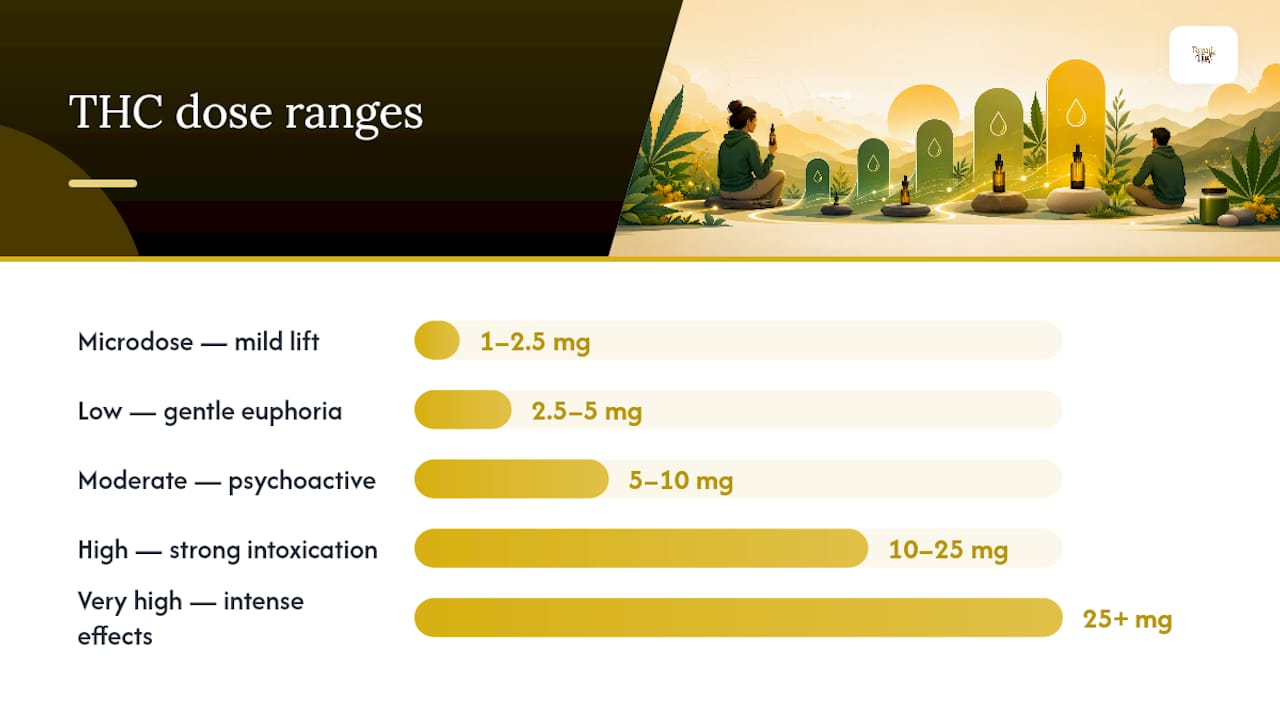
Edibles become noticeably psychoactive around 2.5–5 mg for most people. Standard recreational servings sold in legal markets often run 5–10 mg per piece, which is already two to four times what a first-timer should take.
A few practical notes on each band:
- 1–2.5 mg (microdose): Suited for daytime use when you need to stay sharp. Many people use this range for mild anxiety relief or focus without any noticeable high.
- 2.5–5 mg (low dose): The most common beginner starting point. Social settings, evening relaxation, or sleep support. Impairment is possible, so don’t drive.
- 5–10 mg (moderate): Reserved for people who’ve already confirmed their response at lower doses. Clear cognitive effects and a real risk of anxiety if you’re not ready.
- 10 mg and above: Not a beginner dose. Full stop.
How to titrate your dose across your first sessions
Titration just means finding your minimum effective dose by increasing gradually over multiple sessions, not one sitting. Here’s how to do it safely with edibles first, then vaping.
Edible titration: a 3-session plan
- Session 1: Take 2.5 mg (or 1 mg if you’re being ultra-cautious). Do this on an empty stomach or after a light meal. Wait a full two hours before deciding anything. Seriously, wait the full two hours.
- Session 2 (48+ hours later): If Session 1 felt too mild and you experienced no anxiety or discomfort, increase to 5 mg. Same two-hour wait rule applies.
- Session 3 (48+ hours later): If 5 mg felt comfortable and you want more, consider 7.5 mg. If 5 mg was already strong, stay there. You’ve found your dose.
Never increase your dose within the same session. Edibles are slow. What feels like “nothing happening” at 90 minutes can become overwhelming by hour two.
Vaping titration: a simpler approach
Vaping is actually easier to titrate than edibles because the effects arrive in seconds to minutes rather than hours. One small puff, then a 10–15 minute wait is the standard beginner approach. If you feel nothing after 15 minutes, take a second small puff. Stop there for the session. You can read more about first-session vaping technique to understand puff size and device settings before you start.
Pro Tip: Keep a simple dosing journal. After each session, note the date, product name, mg taken, how long onset took, how strong the peak felt, and how you felt four hours later. Three sessions of honest notes will tell you more about your personal response than any dosing chart.
How long do effects last for edibles vs. vaping?
This is where most beginners go wrong. They take an edible, feel nothing after an hour, take more, and then get hit by both doses at once.
Edibles take 30 minutes to 2 hours to kick in. Peak effects land around 2–4 hours after ingestion. The total experience can run 4–8 hours or longer. Vaping is the opposite: onset in seconds to a few minutes, peak within 30 minutes, and most effects resolved within 2–3 hours.
The reason edibles hit harder and last longer comes down to metabolism. When you eat THC, your liver converts it into 11-OH-THC, a metabolite that crosses the blood-brain barrier more readily than THC itself and produces a more intense, longer-lasting effect. Inhaled THC bypasses this conversion almost entirely.
Session timeline at a glance:
Edibles: Onset 30 min–2 hrs | Peak 2–4 hrs | Duration 4–8+ hrs. Do not redose before the 2-hour mark.
Vaping/Inhalation: Onset seconds–5 min | Peak 15–30 min | Duration 1–3 hrs. Wait 15 minutes between puffs.
For a deeper comparison of inhalation methods and what each means for onset timing, the vaping vs. smoking guide covers the practical differences clearly.
Why two people can react completely differently to the same dose
A 2.5 mg edible that barely touches one person can floor another. That gap isn’t random. Several factors shape your individual response, and knowing yours before you start matters.
Tolerance and prior use. Someone who has never used cannabis has zero tolerance. Even a low dose can feel intense. Prior exposure, even occasional use, changes the baseline significantly.

Body composition and metabolism. THC is fat-soluble, so body fat percentage affects how it’s stored and released. Metabolism speed, partly governed by the CYP2C9 enzyme, determines how quickly your liver processes THC. Slow metabolizers feel effects longer and more intensely.
Food. High-fat meals can substantially increase oral cannabinoid absorption, meaning an edible taken after a fatty meal hits harder than the same dose on an empty stomach. This isn’t a minor variable. It can double the perceived intensity.
Age and sex. Older adults and people with lower body weight tend to be more sensitive. Some research suggests hormonal differences influence THC sensitivity, though the clinical picture is still developing.
Alcohol and other substances. Combining THC with alcohol amplifies both. Even one drink can turn a manageable dose into an uncomfortable experience.
Medications. THC interacts with drugs metabolized by CYP enzymes, including blood thinners like warfarin, some antidepressants, and certain heart medications. NCCIH guidance is clear: if you’re on any regular medication, speak with your GP or pharmacist before using THC. This isn’t a formality. The interactions are real and can be clinically significant.
What happens if you take too much, and what to do about it
Overconsumption of THC is not medically dangerous in the way an opioid overdose is, but it can be deeply unpleasant. Knowing the signs and having a plan makes a big difference.
Common side effects at any dose:
- Anxiety or paranoia, especially at doses above your threshold
- Rapid heartbeat (tachycardia)
- Nausea or dizziness
- Dry mouth and red eyes
- Extreme sedation or difficulty concentrating
Signs that warrant emergency care:
- Unresponsiveness or inability to be woken
- Very slow or labored breathing
- Severe chest pain
- Seizures
If you’ve taken too much, work through this:
- Stay calm. Remind yourself the feeling is temporary and will pass.
- Move to a safe, comfortable space. Lie down if needed.
- Drink water. Hydration helps.
- Distract yourself with something low-stimulation: a familiar TV show, calm music, or slow breathing.
- If you have CBD available, some evidence suggests it may blunt THC’s anxiety effects.
- Call a trusted friend and let them know what’s happening.
- If symptoms are severe or you’re genuinely frightened, call 999 (UK emergency services) or 111 for non-emergency NHS advice.
Storage matters too. Keep all THC products in a locked container, well out of reach of children and pets. Edibles look like regular food. Accidental ingestion by a child is a genuine emergency. In the UK, call 999 immediately if a child has consumed any THC product.
How to read a product label and check lab reports
Potency labeling varies wildly between products, and a vague label is a red flag. Before you take anything, check for these specifics.
| What to Check | What It Should Say | Red Flag |
|---|---|---|
| Total mg per package | Clear number (e.g., “100 mg total”) | “Potent” or no mg listed |
| Mg per serving | Exact figure (e.g., “5 mg per gummy”) | “Serving size varies” |
| Cannabinoid breakdown | THC, CBD, and any D8/D9 distinction | Only “cannabinoids” listed |
| Batch COA (lab report) | QR code or URL to third-party lab | No COA available |
| Solvent/heavy metal screen | Pass on residual solvents and metals | Not tested or no data |
| Terpene panel | Optional but useful for strain effects | Not a red flag if absent |
A certificate of analysis (COA) from a third-party lab is the single most important document. It confirms the actual THC content matches what’s on the label and screens for contaminants. Any reputable product should have one accessible. If it doesn’t, that’s your answer.
For cartridge-specific label checks, the THC cartridge selection guide walks through what to look for on hardware and oil quality.
What’s legal in the UK and what are your lawful options?
THC remains a Class B controlled substance in the UK. Possession carries a penalty of up to five years in prison, and supply carries up to 14 years. This applies regardless of the amount. The Gov and NHS cannabis information are the authoritative sources for current UK law.
There is one lawful medical route. Since 2018, specialist clinicians in the UK can prescribe cannabis-based medicinal products (CBMPs) for specific conditions, including certain epilepsy syndromes, chemotherapy-induced nausea, and MS-related spasticity. These prescriptions are issued through private clinics or, in limited cases, NHS specialist pathways. Access is not straightforward, and general-purpose recreational use does not qualify.
Lawful alternatives worth knowing:
- CBD products: Legal in the UK when derived from approved hemp strains and containing less than 1 mg THC per product. Non-psychoactive, widely available, and useful for some people seeking relaxation or mild anxiety relief without intoxication.
- Clinician-guided cannabinoid therapy: If you have a qualifying condition, a referral to a cannabis clinic (private) or NHS specialist is the correct route.
If you’re uncertain about your legal position or health situation, speak with your GP before proceeding.
The clinical evidence behind conservative dosing
The conservative 2.5 mg starting recommendation isn’t just cautious consumer advice. It reflects a consistent pattern in clinical and review literature.
Review evidence documents a biphasic dose-response for THC, particularly around anxiety: lower doses tend to reduce anxiety in many people, while higher doses can trigger or worsen it. This means the relationship between dose and effect isn’t linear. More isn’t simply more. At some threshold, the direction reverses.
Research on the anxiety-THC relationship also highlights psychiatric vulnerability as a key risk factor. Peer-reviewed literature identifies a meaningful association between high-dose THC use and worsened outcomes in people with a personal or family history of psychosis or schizophrenia.
Groups who should avoid THC or consult a clinician first:
- Pregnant or breastfeeding people
- Anyone with a personal or family history of psychosis, schizophrenia, or bipolar disorder
- People with certain cardiac conditions (THC raises heart rate)
- Anyone taking medications metabolized by CYP2C9 or CYP3A4 enzymes (warfarin, some SSRIs, certain statins)
- Adolescents and young adults (developing brain risk)
If any of these apply to you, speak with your GP or a pharmacist before using any THC product. This is general information, not a substitute for professional medical advice.
Three ready-to-use starter plans you can follow tonight
These plans are designed to be copied directly. Pick the one that fits your situation.
Ultra-conservative edible plan (1 mg start)
- Session 1: Take 1 mg. Wait 2 full hours. Note effects.
- Session 2 (48 hours later): If Session 1 was barely perceptible, increase to 2 mg.
- Session 3 (48 hours later): If 2 mg felt comfortable, move to 2.5 mg.
- Continue in 0.5–1 mg increments per session until you find your threshold.
- Stop increasing once you reach a dose that gives you the effect you want without discomfort.
Standard edible plan (2.5 mg start)
- Session 1: Take 2.5 mg. Wait 2 hours. If effects are mild and comfortable, you’re done for the day.
- Session 2 (48 hours later): If 2.5 mg was too mild, increase to 5 mg.
- Session 3: If 5 mg felt right, that’s your dose. If it was too strong, go back to 2.5 mg.
Vaping plan (1 small puff start)
- Take one small puff from a beginner-friendly disposable.
- Wait 15 minutes. Assess.
- If effects are minimal, take a second small puff. Stop there for the session.
- Next session: repeat and adjust based on your notes.
Quick journal template: Date | Product name | Mg taken | Onset time | Peak intensity (1–10) | How I felt at 4 hrs | Notes
If you notice effects persisting strongly into the next day, pause increases entirely. Your dose is already working. Pushing higher when effects are still present is how overconsumption happens.
Why the “start low” advice is more important than most guides admit
Most dosing guides tell you to start at 2.5 mg and leave it there. What they understate is why that number matters so much for edibles specifically, and why the wait time is the more important variable for most beginners.
The real risk isn’t the first dose. It’s the second one, taken because the first didn’t seem to do anything after 45 minutes. That second dose, layered on top of the first that’s still working its way through your digestive system, is what produces the overwhelming experiences people describe. The 2-hour wait rule isn’t conservative caution. It’s the actual pharmacology of oral THC.
Vaping is genuinely more forgiving in this respect. The feedback loop is fast enough that you know within 15 minutes whether you’ve taken enough. That’s one reason vaping as a first-session format can actually be a smarter choice for some beginners than edibles, despite edibles feeling more approachable. The dose control is better when the onset is faster.
The other thing most guides skip: your first session is data collection, not recreation. Go in with that mindset and you’ll make far better decisions about every session after it.
Thcvapesuk has lab-tested starter options ready to ship across the UK

If you’ve read this far and you’re ready to try a controlled, low-dose first session, Thcvapesuk carries lab-tested vapes and THC gummies with clear per-serving mg labeling, so you’re not guessing at your dose. Every product ships discreetly across the UK, and the range covers beginner-friendly potency levels from Stiiizy, Dabwoods, and Packman alongside lower-dose edible options. Browse the full range at Thcvapesuk or go straight to the beginner vape guide to find a vetted starter option matched to your first session.
Sources
- Trycannabis
- Cannabis Edibles Dosage Guide for Beginners 2026 | WeedVader
- Cannabis (marijuana) and cannabinoids: What you need to know | NCCIH
- Pmc
- Pubmed
