


THC vape cartridges do expire in the sense that matters most: they degrade. Potency drops, terpenes evaporate, and oil can darken or separate. Most carts don’t become acutely toxic on a printed date, but contamination or hardware failure can make a degraded cart genuinely unsafe to inhale.
Quick timeline snapshot:
- Unopened cart, good storage: peak quality for roughly about 12 to 18 months, sometimes usable up to 18–24 months depending on formulation
- Opened cart: quality declines noticeably within a few months of first use
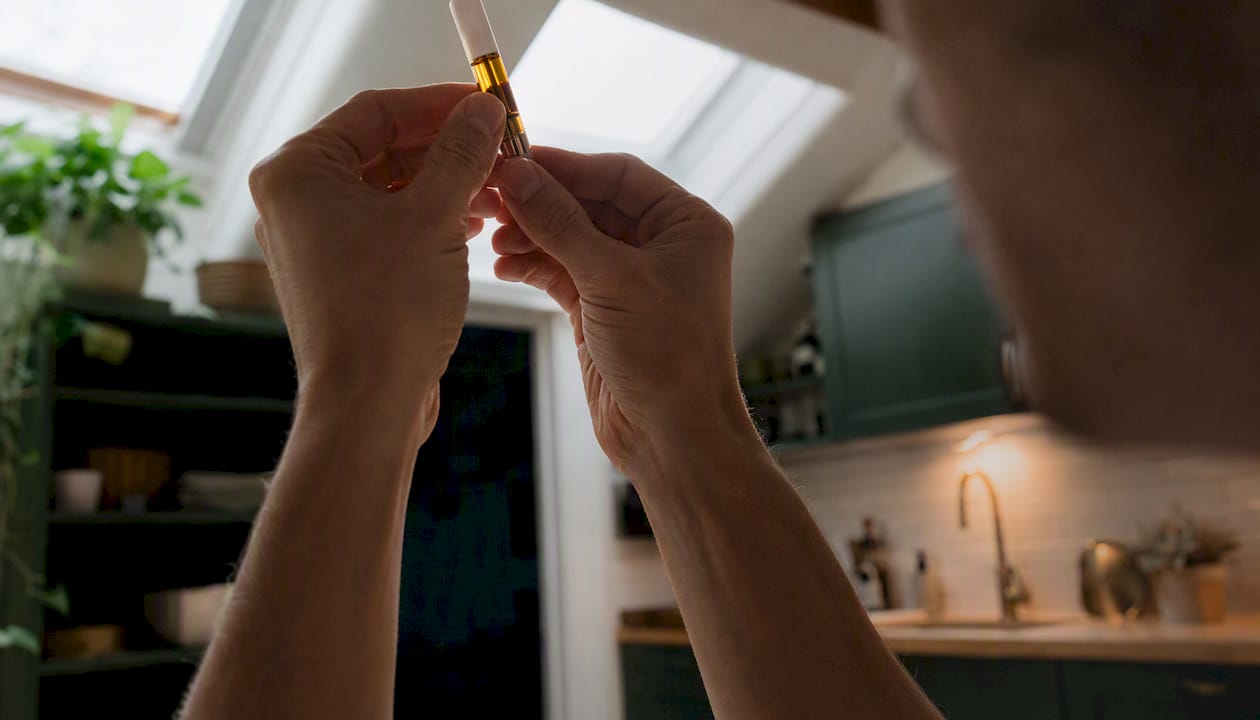
Right now, if you’ve found an old cart: hold it up to light and check for dark brown or near-black oil, cloudiness, floating particles, or visible separation. Smell the mouthpiece for anything musty or sour. If either check fails, discard it.
Key Takeaways
THC vape cartridges degrade over time through oxidation and terpene loss, with most carts holding peak quality for about 12 to 18 months unopened and declining noticeably within months of first use.
| Point | Details |
|---|---|
| Carts do expire (by quality) | Potency and flavor decline through oxidation; contamination or hardware failure can create genuine safety risk. |
| Unopened shelf life: about 12 to 18 months | Distillate carts last longer; live-resin carts degrade faster and are best used within 6–12 months. |
| Top discard signs | Dark brown/black oil, cloudiness, musty or chemical smell, burnt taste on low voltage. |
| Best storage rule | Store upright, cool (60–70°F / 15–21°C), dark, and capped; remove from battery when idle. |
| Thcvapesuk for verified carts | Lab-tested inventory with COAs and batch info, shipped discreetly across the UK. |
Table of Contents
- Do carts expire — what’s actually happening inside?
- How long do carts last — unopened vs. opened?
- How to tell if a cart has gone bad
- Are expired or degraded carts unsafe?
- How to store carts to maximize shelf life
- Reading manufacture dates, expiry labels, batch numbers, and COAs
- Why lab-tested carts reduce your actual risk
- Can I use a 1–2 year old cart? How to inspect and decide
- Why we emphasize lab testing and practical checks
- Fresh, lab-tested carts shipped across the UK
- Sources
Do carts expire — what’s actually happening inside?
“Expiration” for a THC cartridge isn’t a single event. It’s a slow chemical slide driven by oxidation, heat, and time, occasionally interrupted by a hardware failure that makes things worse faster.
The main chemical drivers:
- Oxidation: Oxygen reacts with THC and terpenes, breaking them down and darkening the oil. This is the single biggest cause of potency loss in stored carts.
- Terpene volatility: Terpenes are fragile aromatic compounds. They evaporate or oxidize faster than cannabinoids, which is why an old cart often tastes flat before it loses much THC.
- THC-to-CBN conversion: Over time, THC slowly converts to cannabinol (CBN), a mildly sedating cannabinoid with far less psychoactive effect. The cart still “works,” but the effect is weaker and different.
- Carrier oil changes: Cutting agents like MCT oil or PG can separate or thicken with temperature swings, affecting viscosity and vapor production.
Hardware failure is a separate track. Coils corrode, rubber seals dry out, and wicking material degrades with repeated heat cycles. A cart that’s been used and stored repeatedly can develop micro-leaks or a burnt coil long before the oil itself is chemically degraded. The four external drivers that accelerate all of this:
| Driver | Consequence |
|---|---|
| Heat | Speeds oxidation and terpene loss; softens seals and causes leaks |
| Light (UV) | Breaks down cannabinoids directly; accelerates color change |
| Oxygen | Primary cause of THC degradation and oil darkening |
| Moisture | Promotes microbial growth and can corrode metal hardware |
How long do carts last — unopened vs. opened?
The honest answer depends on two things: whether the cart has been opened, and what’s inside it.
Unopened carts in their original sealed packaging, stored in a cool dark place, hold near-peak quality for roughly 12 to 18 months. Industry reporting puts the outer usability window at 18–24 months for well-stored cartridges, though quality is noticeably lower by that point. Formulation matters a lot here. Distillate-based carts contain fewer volatile compounds and tend toward the longer end of that range. Live-resin and rosin carts, which are packed with fragile terpenes, degrade faster and are better treated as a 6–12 month product even unopened.
Opened carts face a different problem. Every pull draws in a small amount of air, and oxygen exposure combined with repeated heating accelerates terpene loss and THC conversion. Practically speaking, an opened cart used occasionally will taste noticeably flatter within 2–3 months and may show visible darkening within 4–6 months.
Factors that push a cart toward the shorter end of its range:
- High storage temperature (a car dashboard in summer can hit 60°C+)
- Frequent use cycling (heat-cool-heat-cool stresses seals)
- Loose or missing mouthpiece cap
- High device voltage settings
- Thin or low-quality packaging
Pro Tip: Label your opened date on the cart or its box with a marker. Aim to finish it within 2–3 months for the best flavor and potency. After that, it’s not necessarily unsafe, but you’re getting a noticeably diminished product.
How to tell if a cart has gone bad
A quick inspection takes about 60 seconds and can save you from a genuinely unpleasant experience.
Visual checks:
- Oil color: Fresh distillate is pale gold to amber. Live resin runs slightly darker. Near-black or dark brown oil is a clear sign of heavy oxidation.
- Cloudiness or separation: Hazy oil, two visible layers, or floating particles suggest breakdown or contamination.
- Crystals or sediment: Some crystallization in high-terpene carts is normal at cold temperatures and clears with gentle warming. Persistent sediment that doesn’t dissolve is a red flag.
- Hardware condition: Cracks in the tank, corroded contacts, or a leaking mouthpiece mean the seal has failed. Visible growth or unusual particles are an automatic discard.
Sensory checks:
- Smell: A fresh cart smells of cannabis terpenes, sometimes fruity, piney, or earthy depending on strain. Musty, sour, rancid, or chemical odors mean something has gone wrong.
- Taste: Take a short primer pull at your device’s lowest voltage setting. A burnt, metallic, or acrid taste that doesn’t clear after one or two pulls is a sign the coil is degraded or the oil has broken down.
Performance checks:
- Weak vapor output at normal settings
- Persistent clogging that doesn’t clear with gentle warming
- Inconsistent hits or a gurgling sound on draw
- Higher resistance than usual (if your device shows resistance)
If you need to document a problem for a supplier return, photograph the cart against a white background in natural light: one shot of the oil color, one of any visible hardware damage, and one of the label showing the batch number.
Warning: Musty odor, visible particles, or any sign of growth means discard immediately. Do not attempt to filter, clean, or reheat the oil for reuse.
Are expired or degraded carts unsafe?
This article provides general information, not medical advice. If you experience respiratory symptoms after vaping, consult a healthcare professional.
Most age-related changes in a THC cart are quality issues, not safety emergencies. Weaker effects and flat flavor are annoying, not dangerous. The risk profile changes when contamination enters the picture.
Peer-reviewed respiratory health research indicates that inhaling contaminated or thermally degraded aerosols can increase respiratory irritation and may pose risks in susceptible individuals. Burnt coil residue, oxidized carrier oils, and microbial contamination all produce aerosol compounds that differ from what a fresh, clean cart delivers. That’s the real argument for a conservative discard policy when you see contamination markers.
Health red flags that warrant stopping immediately:
- Throat or airway irritation that persists after a session
- Unusual coughing fits or a persistent dry cough
- Chest tightness or pain after use
- Nausea or dizziness beyond normal THC effects
- Any symptom that doesn’t resolve within a few hours
Action steps if you’re concerned: Stop using the cart. Keep it sealed in a bag in case your supplier or a medical professional needs to inspect it. Seek medical attention if symptoms are severe or breathing difficulties persist. Don’t dismiss respiratory symptoms as “just the weed.”
How to store carts to maximize shelf life
Good storage is the single biggest lever you have over a cart’s lifespan. The difference between a cart kept in a bedside drawer versus one left in a car for a month is dramatic.
Do:
- Store upright so oil stays over the wick and doesn’t pool around the seal
- Keep in original packaging, which is designed to limit light and air exposure
- Aim for a cool, dark, dry location at typical room temperature (around 60 to 70°F or 15 to 21°C) — a bedroom drawer or cupboard works well in most UK homes
- Keep the mouthpiece cap on between uses
- Remove the cart from the battery when you’re not using it for more than a day or two
- Write your opened date on the packaging
Don’t:
- Leave carts in a car, near a window, or anywhere that gets direct sunlight
- Store in a bathroom (humidity corrodes contacts and promotes microbial growth)
- Keep attached to a battery long-term (trickle charge and heat from the device accelerate degradation)
- Freeze a cart (cold thickens oil and can crack hardware; condensation on warming causes moisture problems)
Pro Tip: If a cart has been left somewhere warm, don’t vape it immediately. Let it cool to room temperature for 15–20 minutes first. Warm oil is thinner and more likely to flood the coil, causing a burnt hit. Refrigeration is generally not recommended, but if you do refrigerate, always let the cart reach room temperature fully before attaching to a battery.
Reading manufacture dates, expiry labels, batch numbers, and COAs
Not every cart comes with a clear expiry date, and that’s where knowing what to look for matters.
Where to find the key fields:
- Manufacture or pack date: Usually on the bottom or side of the box, sometimes on a sticker on the cart itself. Format varies: DD/MM/YYYY, MM/YYYY, or a batch code that encodes the date.
- Best-by or expiry date: Less common but increasingly present on licensed-market products. Treat it as a quality benchmark, not a hard safety cutoff.
- Batch or lot number: A string of letters and numbers that links the product to its production run. Keep this if you need to make a complaint or request a COA.
- COA link or QR code: Many reputable brands print a QR code on the box that links to the third-party lab report for that batch. Scan it before first use.
When only a manufacture date is shown, a reasonable working rule is to expect best quality within 6–12 months of that date for most formulations. Beyond 12 months from manufacture, inspect carefully before use.
Key COA fields and what they tell you:
| COA Field | What It Indicates |
|---|---|
| Cannabinoid profile (THC %, CBD %) | Confirms potency matches label claims |
| Terpene report | Verifies flavor compounds are present at stated levels |
| Pesticide screen | Confirms no agricultural chemical residues above safe limits |
| Residual solvent screen | Checks for leftover extraction solvents |
| Microbial results | Screens for mold, yeast, and bacteria |
| Date tested | Confirms the test is recent enough to be meaningful |
If a product has no COA and no batch number, that’s a significant warning sign. Retain your packaging and COA for at least 30 days after purchase in case you need to make a return or report a health concern. For more on what UK labeling and testing expectations look like in practice, that context is worth reviewing before you buy.
Why lab-tested carts reduce your actual risk
A COA isn’t just paperwork. It’s the difference between knowing what’s in your cart and guessing.
How to read a COA for safety:
- Check the date tested first. A COA from 18 months ago tells you little about the current batch.
- Look for a pesticide screen with results below the relevant action limits. Pesticide residues concentrate in extracted oil.
- Confirm the residual solvent screen shows no flagged solvents. Poorly purged extracts can contain butane, propane, or ethanol at levels that cause irritation.
- Review microbial results for mold and yeast counts. These matter especially for live-resin products, which are less processed.
- Cross-check the cannabinoid profile against the label. A cart claiming 90% THC that tests at 60% is misrepresented.
Lab-tested COAs materially reduce consumer uncertainty by showing contaminant screens and measured cannabinoid levels. That matters especially for older stock, where age-related decline could otherwise mask a contamination problem. Thcvapesuk makes COA access a standard part of its product listings, so you can verify what you’re buying before it arrives. For a deeper look at why lab testing matters for every cart purchase, that resource covers the full picture.
Pro Tip: Keep the COA and original packaging for at least 30 days after purchase. If you develop any respiratory symptoms or the product behaves unexpectedly, that documentation is what a supplier or medical professional will ask for first.
Can I use a 1–2 year old cart? How to inspect and decide
Found a cart at the back of a drawer? Here’s a practical decision workflow before you take a pull.
Step 1: Visual inspection. Hold the cart up to a light source. Oil should be clear to amber, not dark brown or black. No cloudiness, no floating particles, no visible separation. Check the hardware for cracks, corrosion, or leaking.
Step 2: Smell test. Remove the mouthpiece cap and take a gentle sniff. Cannabis terpenes, even faded ones, should be the dominant note. Anything musty, sour, or chemical means discard.
Step 3: Device check before you blame the oil. Hardware issues frequently mimic oil spoilage. Before concluding the oil is bad, check that the battery is charged, the contacts are clean, and the airflow isn’t blocked. A cart that produces weak vapor on a dead battery isn’t degraded — it’s just underpowered. For beginners especially, ruling out device issues first saves a lot of unnecessary discards.
Step 4: Low-voltage primer pull. Set your device to its lowest voltage (typically low voltage around 2.4 to 2.8 volts). Take one short, slow pull and evaluate. Good signs: visible vapor, recognizable cannabis flavor even if faint. Bad signs: burnt taste, metallic flavor, acrid chemical note, or no vapor at all.
Decision guide:
- Passes all four steps? The cart is likely still usable, though potency and flavor will be reduced compared to fresh.
- Fails visual or smell? Discard. No pull is worth the risk.
- Fails taste on low voltage? Discard. A burnt coil or degraded oil won’t improve at higher settings.
- Hardware suspected? Try a different battery before writing off the oil.
For a cart that’s 1 year old and stored well, passing inspection is genuinely possible. At 2 years, the odds of meaningful potency and flavor are low even if it passes, and the inspection becomes more critical, not less.
Why we emphasize lab testing and practical checks
Thcvapesuk’s position on this is straightforward: a cart you can’t verify is a cart you’re taking a risk on. Every product listed on the site carries a COA from third-party testing, covering cannabinoid levels, pesticide screens, residual solvents, and microbial results. That’s not a marketing claim — it’s the minimum standard that makes practical inspection checks meaningful in the first place.
The UK market for THC vape products includes a significant volume of unverified and counterfeit products. A review of cartridge safety issues and counterfeit risks in the UK context shows how common misrepresented products are and what the real-world consequences look like. Lab testing doesn’t eliminate every risk, but it closes the gap between what the label says and what’s actually in the cart.
Adults in the UK using THC vape products should do so responsibly and in accordance with applicable law.
Fresh, lab-tested carts shipped across the UK
If the cart you just inspected didn’t pass, or you want to start with something you can actually verify, Thcvapesuk carries a curated range of lab-tested THC cartridges and disposables from brands including Dabwoods, Stiiizy, Muha Meds, Raw Garden, and Packman, all with COAs available and shipped discreetly across the UK.

Every product comes with batch information and third-party lab results so you know exactly what you’re getting before you open the box. If you’re replacing a degraded cart and want to compare options by potency, strain type, or formulation, the best THC vape brands guide is a good starting point. COA documentation and returns information are available for every order.
Sources
- Do weed pens expire? Here’s what you need to know | Weedmaps
- Do Vape Carts Expire? Safety & Shelf Life
- PMC article (vaping-related respiratory health review)
- Do THC Carts Expire? A Guide to Vape Cartridge Shelf Life
This article is general information, not a substitute for advice from a qualified doctor. Consult a qualified healthcare professional about your own circumstances before acting on anything here.
