


Yes, rechargeable THC disposables are real, widely available, and generally the smarter buy when you want high puff counts without leaving oil behind. The tradeoff is straightforward: you get a device with a visible USB-C or micro-USB port, a battery sized to outlast the oil reservoir (typically 500–650 mAh), and puff counts in the high thousands — numbers that only make sense when the battery can be topped up several times. Single-use disposables die before the oil runs out. Rechargeable ones don’t.
Three things to confirm before you buy: a visible charging port (USB-C or micro-USB), a Certificate of Analysis (COA) linked on the product page, and a stated battery mAh or puff-count claim. If any of those are missing, move on. Thcvapesuk lists all three for every product it carries.
Pro Tip: Avoid any rechargeable disposable that doesn’t publish a COA. Potency claims without lab verification are marketing, not fact.
Table of Contents
- What are rechargeable THC disposables and how do they differ?
- Pros and cons of rechargeable disposables
- How to charge, use, and troubleshoot your device
- What buying criteria actually matter?
- Brand examples you’ll see in U.S. retail
- Safety and U.S. legal context
- Where to buy and what to expect on price
- Why rechargeable disposables let you use more of your oil
- Key Takeaways
- The case for being selective about what you charge
- Thcvapesuk carries what this article describes
- Useful sources for verifying product claims
What are rechargeable THC disposables and how do they differ?
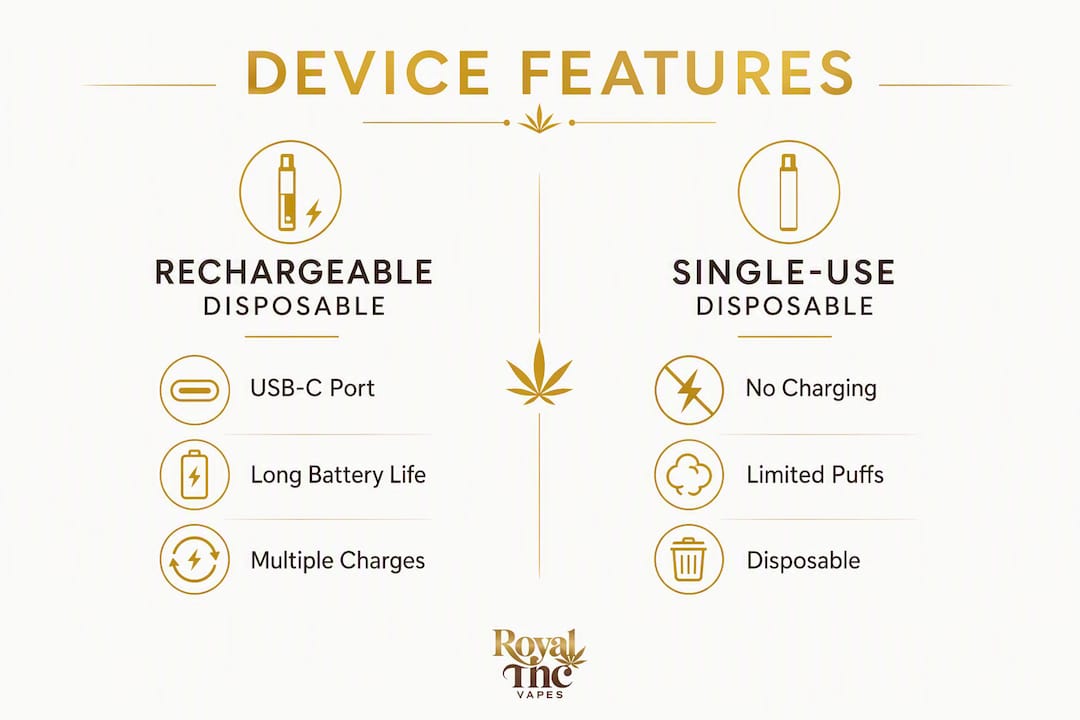
A rechargeable THC disposable is a prefilled vape pen with a built-in battery that you can charge multiple times until the oil reservoir is empty. The device is still disposable in the sense that you don’t refill it or swap cartridges — once the oil is gone, you recycle the unit. What changes is the battery design: instead of a small cell that dies mid-tank, the battery is sized to need several charges across the device’s life.
That distinction separates rechargeable disposables from two other common formats:
- Single-use disposables have a sealed base with air holes and no charging port. The battery is undersized by design, which means many users hit a dead battery before the oil is exhausted. Wasted oil is the defining frustration.
- 510 cartridges are refillable or replaceable tanks that screw onto a separate 510-thread battery. You buy the battery once and swap carts. More flexible, but two pieces to manage instead of one.
Identifying a rechargeable model is simple: look for a charging port on the bottom or side of the chassis. USB-C is the current standard on newer devices. Micro-USB still appears on older or budget models. A few brands use proprietary connectors, which is worth noting because a lost cable means a dead device. Non-rechargeable units have a sealed base with only air holes — no port at all.
| Feature | Rechargeable Disposable | Single-Use Disposable | 510 Cartridge |
|---|---|---|---|
| Battery | Built-in, rechargeable (USB-C/micro-USB) | Built-in, sealed | Separate 510 battery |
| Refillable | No | No | Yes (or swappable) |
| Puff count | Typically 10–25 ml of oil in rechargeable designs, which correlates to advertised puff counts (see below) | ||
| Charging port | Yes (USB-C, micro-USB, proprietary) | No | N/A (battery charged separately) |
| Best for | Convenience + full oil use | Short-term, low-volume | Flexibility, flavor variety |

Pros and cons of rechargeable disposables
The case for rechargeable disposables is mostly about value and waste. Manufacturers design them specifically so users can consume the entire oil reservoir — that alone justifies the slightly higher upfront price for anyone who vapes regularly.
Pros:
- Less wasted oil means a lower effective cost per puff over the device’s life.
- High puff counts (5,000–20,000) suit heavy weekend users who don’t want to carry backup devices.
- Consistent voltage delivery across charges keeps flavor and potency more stable than a dying single-use battery.
- USB-C charging works with cables most people already own.
- No separate battery to track or charge independently.
Cons:
- Battery care is required. Leaving a lithium cell fully depleted for days shortens its lifespan.
- Opaque reservoirs make it hard to gauge remaining oil, so you’re guessing when you’re close to empty.
- Coil degradation happens before the battery fails on high-puff devices — burnt flavor is a coil issue, not a charging one.
- Disposal requires more care than tossing a standard disposable; lithium batteries need proper recycling.
Heavy or daily users get the most from rechargeable disposables. If you vape occasionally and want zero maintenance, a small single-use device might fit better. If you want maximum flexibility and don’t mind two pieces of hardware, a 510 setup is worth considering.
How to charge, use, and troubleshoot your device
Charging a rechargeable disposable is straightforward, but the charger choice matters more than most people realize.
- Identify the port. Check the bottom or side of the device for a USB-C or micro-USB port. If you see only air holes, the device is not rechargeable.
- Use a low-output source. Plug into a computer USB port or a 1A wall adapter. Slow, steady charging preserves small lithium-ion cells.
- Connect the cable. Most devices don’t include a cable in the box — manufacturers expect you to use an existing USB-C or micro-USB cable.
- Watch the LED. The light typically pulses while charging and turns solid or shuts off when full. Charge time runs 30–90 minutes depending on battery capacity.
- Unplug when done. Don’t leave a small lithium cell charging overnight.
Troubleshooting checklist when the device won’t charge:
- Swap the cable first. Most charging failures trace back to the cable or debris in the port, not the device itself.
- Inspect the port for pocket lint or dust. A toothpick or a short burst of compressed air often clears it.
- Try a different power source (wall adapter vs. computer port).
- A blinking LED after a full charge cycle can mean the oil is exhausted or there’s an internal fault — not always a battery problem.
- Thin, burnt flavor with a charged battery points to coil degradation, not a charging issue.
Pro Tip: Avoid 20W–60W fast-charger bricks designed for phones. They can overwhelm small disposable batteries, generate heat, and shorten the cell’s usable life significantly.
What buying criteria actually matter?
Most product pages bury the specs that matter. Here’s what to look for before you add anything to your cart:
- Charging port type: USB-C is preferable. Proprietary ports are a liability.
- Battery capacity (mAh): Higher mAh means more charges before degradation. Typical range is moderate battery capacity for rechargeable disposables.
- Oil capacity (mL/g): Larger reservoirs justify the rechargeable design. Anything under 2 mL in a “rechargeable” device is a red flag.
- THC percentage / potency: Stated on the label, but only meaningful when backed by a COA.
- COA availability: A lab-tested THC cart should have a scannable QR code or a direct link to third-party lab results showing potency, residual solvents, pesticides, and heavy metals.
- Strain and flavor options: Sativa, indica, and hybrid classifications affect the experience; live resin options typically deliver stronger terpene profiles than distillate.
- Price per unit and per puff: Divide the retail price by the advertised puff count for a rough cost-per-puff comparison.
- User ratings and seller licensing: Verified reviews and a licensed dispensary or retailer are non-negotiable trust signals.
| Spec | What to look for | Why it matters |
|---|---|---|
| Battery / charging | USB-C preferred; 500–650 mAh | Runtime and safety |
| Capacity | 10–25 ml is typical for rechargeable disposables (aligns with large oil reservoirs) | Justifies rechargeable design |
| Potency / THC % | Backed by COA | Accuracy of label claims |
| Price | Retail range varies by brand | Cost-per-puff comparison |
| Strain/flavor | Sativa, indica, hybrid; live resin vs. distillate | Experience and flavor fidelity |
| Lab testing / COA | Third-party, linked on product page | Safety and potency verification |
Brand examples you’ll see in U.S. retail
These five brands appear consistently across licensed dispensaries and online retailers. What they offer varies, so knowing what each typically advertises saves time when browsing menus. For a deeper look at how these brands compare on hardware and flavor, the best THC disposable brands guide covers specs and strain options in more detail.
- Stiiizy is best known for its proprietary pod system, but the brand also produces LIIIL STIIIZY disposable vapes in compact formats with rechargeable batteries. Potency tends to run high, and COAs are generally accessible through their site.
- Dabwoods offers disposable vape pens with a range of strain options. Verify hardware specs and COA links on any Dabwoods listing before purchasing, as product lines vary by retailer.
- Packman has built a following around high-potency liquid diamond and live resin disposables. Their 4G rechargeable disposables are among the larger-capacity options available through licensed retailers.
- Muha Meds produces rechargeable disposables with clearly stated THC percentages and a reputation for consistent distillate quality. COA availability varies by batch, so check the product page directly.
- Raw Garden focuses on live resin products with strain-specific terpene profiles. Their disposables tend to appeal to flavor-focused consumers rather than those chasing raw potency numbers.
Regional availability differs significantly. California dispensaries carry most of these brands reliably. Other states may have limited SKUs or no access at all depending on local licensing. Always confirm your state’s licensed retailers before ordering.
Safety and U.S. legal context

THC is federally classified as a Schedule I controlled substance. State law governs whether you can legally purchase, possess, or use THC disposables where you live. Recreational cannabis is legal in roughly half of U.S. states as of 2026; medical-only states require a valid patient card. Buying from a licensed dispensary or a state-authorized online retailer is the only legally sound approach regardless of where you are.
Attempting to charge a non-rechargeable disposable by hacking the device is dangerous — risks include fire and thermal runaway. Only charge devices that have a designated port.
Battery safety checklist:
- Use low-current charge sources (computer USB or 1A adapter).
- Never leave a charging device unattended for extended periods.
- Inspect the port for debris before plugging in.
- Replace frayed or damaged cables immediately.
- Unplug when the LED signals a full charge.
What a COA should show: potency (total THC and CBD percentages), residual solvents, pesticide screening, and heavy metals. A COA without a third-party lab name and batch number is not a real COA.
Pro Tip: Some jurisdictions limit prefilled reservoir sizes — EU and UK regulations cap e-liquid volumes in ways that make large rechargeable disposables uncommon there. The U.S. market has no equivalent federal cap, which is why 10 mL+ rechargeable devices are far more prevalent here.
Disposal: Rechargeable disposables contain lithium-ion batteries and cannot go in regular trash. Drop them at a retailer battery-recycling bin, a local hazardous-waste collection event, or a Call2Recycle location. Many dispensaries accept used devices.
This article is general information, not legal or medical advice. Verify your state’s current cannabis laws with your state’s cannabis regulatory authority or a qualified professional before purchasing.
Where to buy and what to expect on price
Three main channels exist for purchasing rechargeable THC disposables in the U.S.:
- Licensed dispensaries: The most reliable option for verified products. Staff can confirm COA availability and hardware specs in person. Prices tend to be higher than online, but you eliminate counterfeiting risk.
- Licensed online retailers: Convenient and often better priced, particularly for bulk or bundle purchases. Confirm the retailer holds a valid state license and ships to your state legally. Check the current specials at Thcvapesuk for current price examples on lab-tested options.
- Manufacturer direct pages: Some brands sell direct, which guarantees authenticity but limits your ability to compare across brands in one session.
Price ranges vary by brand tier and oil type. Economy rechargeable disposables typically run lower per unit; premium live resin or liquid diamond options from brands like Packman or Raw Garden sit at the higher end. Calculate cost per puff by dividing the retail price by the advertised puff count — that number is more honest than the sticker price alone.
Pro Tip: Many manufacturers don’t include a charging cable in the box to reduce cost and packaging waste. Confirm cable inclusion before you buy, or keep a spare USB-C and micro-USB cable in your kit.
Why rechargeable disposables let you use more of your oil
The core engineering reason is simple: a large oil reservoir needs multiple charges to outlast it. Rechargeable disposables are specifically designed so the battery can be topped up several times, allowing users to consume the entire reservoir rather than discarding oil along with a dead battery.
“Most charging problems are cable-related. Swapping cables often solves the issue without a device return.” — Hamilton Devices hardware specialists
That observation from Hamilton Devices holds up across user reports. The port and cable are the weakest links, not the cell itself. A clean port and a quality cable extend the effective life of the device considerably.
Signs your coil is failing, not your battery:
- Flavor turns thin, harsh, or burnt despite a full charge.
- Vapor production drops noticeably even with a charged battery.
- The LED shows a full charge but the draw tastes scorched.
Pro Tip: Most rechargeable disposables are designed for a fixed number of charge cycles before the coil or cell degrades noticeably. Expect 3–5 full recharges on a typical 500–650 mAh device before flavor quality starts to drop. If the oil runs out before that, the design is working correctly.
For guidance on getting the smoothest draw from your device, the smooth-hitting THC vape guide covers technique and device selection in practical terms.
Key Takeaways
Rechargeable THC disposables deliver full oil extraction, higher puff counts, and lower cost per puff than single-use devices — provided you charge safely, verify COAs, and buy from licensed retailers.
| Point | Details |
|---|---|
| Identify rechargeability | Look for a USB-C or micro-USB port on the device chassis — no port means no recharging. |
| Charge safely | Use a 1A adapter or computer USB port; avoid 20W+ fast chargers that can damage small lithium cells. |
| Verify the COA | Confirm third-party lab results showing potency, solvents, pesticides, and heavy metals before buying. |
| Puff count context | Most modern rechargeable disposables contain 10–25 ml of oil and advertise puff counts such as 5,000–20,000; these designs usually include a charging port. |
| Thcvapesuk selection | Thcvapesuk carries lab-tested rechargeable disposables from Stiiizy, Dabwoods, Packman, Muha Meds, and Raw Garden with COAs and hardware specs listed. |
The case for being selective about what you charge
Most buyers focus on potency and flavor, which is reasonable. What gets overlooked is the hardware underneath those numbers. A 90% THC claim on a device with a proprietary charging port and no COA link is a liability, not a feature. The oil might be exactly what the label says, or it might not — and without a third-party lab report, there’s no way to know.
The rechargeable format is genuinely better than single-use for anyone who vapes with any regularity. Wasted oil is wasted money, and a dead battery at 60% oil remaining is a design failure, not a feature. But the format only delivers on its promise when the hardware is honest about its specs and the oil is verified by a real lab.
What I’d push back on is the assumption that a higher puff count automatically means better value. A 20,000-puff claim on a device with no COA and a mystery charging port is not a deal. A 5,000-puff device from a licensed brand with a scannable batch COA and a USB-C port is. The number on the box is the last thing to evaluate, not the first.
Thcvapesuk carries what this article describes

Thcvapesuk stocks lab-tested rechargeable THC disposables from the brands covered here — Stiiizy, Dabwoods, Packman, Muha Meds, and Raw Garden — with COAs, hardware specs, and strain options listed on every product page. No guessing on potency, no mystery ports. The full selection of THC vapes and disposables is available with discreet shipping, and the 10 best THC vape brands guide on the site breaks down which brands and formats suit different use cases. If you’re new to rechargeable disposables and want a starting point, browse the current catalog and filter by brand or strain type to find a device that matches your tolerance and preferred experience.
Useful sources for verifying product claims
Before purchasing any rechargeable disposable, these sources help you verify hardware specs, charging guidance, and COA standards:
- How to Recharge a Disposable Vape (Innokin): Covers port identification, charge times, and why rechargeable designs exist for large reservoirs.
- Can You Recharge a Disposable Vape? (Vapor Authority): Explains puff-count logic, LED behavior, and charger selection.
- How to Charge a Disposable Vape Pen Correctly (Vapor Authority): Detailed guidance on charger output, cable quality, and battery care.
- How to Fix a Dispo That’s Not Charging (Hamilton Devices): Hardware-specialist troubleshooting for cable and port failures.
- Recharge a Disposable Vape Safely (wikiHow): Covers the risks of attempting to charge non-rechargeable devices.
What a product page should show before you buy:
- A direct link or QR code to a third-party COA with a batch number.
- Battery mAh and charging port type listed in the hardware specs.
- Seller licensing information or a dispensary license number.
- Strain classification (sativa, indica, hybrid) and oil type (distillate, live resin, liquid diamonds).
If any of those four are missing, the listing is incomplete. A licensed retailer with nothing to hide publishes all of them.
