


THC gummies differ along four axes that actually matter: cannabinoid profile and formulation (THC-only, THC+CBD, microdose, high-potency), strain and terpene labeling (sativa, indica, hybrid), infusion and manufacturing method (distillate, full-spectrum live resin, isolate, nanoemulsion), and delivery technology (standard vs. fast-acting onset). Get those four right and you can match almost any gummy to a specific goal. Get them wrong and you end up with a 10 mg piece that hits like a freight train two hours after you thought nothing was happening.
- Cannabinoid profile: determines the type and intensity of the high (or the absence of one, in CBD-heavy ratios)
- Strain/terpene label: shapes the character of the experience, though not as reliably as marketing suggests
- Infusion method: affects flavor fidelity, consistency, and what the COA should show
- Delivery tech: controls when effects begin and how long they last
According to beginner guidance, a safe starting dose is a low amount of THC, while many pre-packaged gummies contain higher doses per piece. Thcvapesuk carries lab-tested options across all these categories, with potency clearly listed per piece.
Pro Tip: Before buying any gummy, confirm a Certificate of Analysis (COA) is available for that specific batch. If the vendor can’t produce one, skip it. Start with 1–3 mg and wait at least 90 minutes before considering a second dose.
Table of Contents
- 1. What do the different types of THC gummies actually mean?
- 3. How gummies are made: infusion methods and what they mean for quality
- 4. Dosing and safety: what the research actually recommends
- 5. Onset and duration: standard edibles vs. fast-acting formulations
- 6. How to read labels and COAs before you buy
- 7. Legal and health considerations in the United States
- 8. Practical selection guide: match the gummy to your goal
- Key Takeaways
- The case for treating lab testing as the baseline, not the bonus
- Thcvapesuk carries lab-tested gummies with clear potency per piece
- Useful sources
1. What do the different types of THC gummies actually mean?
The phrase “THC gummy” covers a wide range of products, and the label alone rarely tells you enough. Here’s how the major formulation categories break down.
THC-only / THC-dominant gummies contain delta-9 THC as the primary or sole active cannabinoid. Potency per piece ranges from low milligram amounts for beginners to higher doses for experienced users. These deliver the most direct psychoactive experience with no cannabinoid modulation.
THC+CBD balanced formulas (1:1 and other ratios) pair THC with cannabidiol. Harvard Health notes that CBD is non-intoxicating and can soften THC’s psychoactive edge, which makes 1:1 products a common choice for people who want effects without intensity. A 5 mg THC / 5 mg CBD piece behaves noticeably differently from a 5 mg THC-only piece.
THC + minor cannabinoid blends add CBN (cannabinol) or CBG (cannabigerol) to the formula. CBN is commonly marketed for sleep support; CBG appears in “focus” or daytime products. The clinical evidence for these specific use-cases is still limited, so treat those claims as directional rather than guaranteed.
Microdose products deliver 1 mg or less to roughly 2.5 mg per piece. They’re designed for people who want subtle effects, functional daytime use, or careful titration. Standard-dose gummies generally contain doses suitable for recreational users, while high-potency products contain more THC designed for experienced users.
| Category | Per-Piece THC Range | Typical Use Case |
|---|---|---|
| Microdose | 1–2.5 mg | Beginners, daytime, titration |
| Low dose | 2.5–5 mg | Casual use, new users stepping up |
| Standard dose | 5–10 mg | Recreational, experienced users |
| High potency | 10 mg or more | High-tolerance users, specific medical needs |
Labeling patterns to read carefully: look for per-piece mg (not just total package mg), serving count, and THC/CBD ratio. A package labeled “150 mg total” with 30 pieces contains 5 mg per piece. That’s very different from a 10-piece pack at the same total.
Legal note: Cannabinoid homologues like delta-8 THC and delta-10 THC occupy a regulatory gray area. Legality varies by state, and testing standards for these compounds are inconsistent. Confirm your state’s current rules before purchasing any product labeled with a cannabinoid other than delta-9 THC.
3. How gummies are made: infusion methods and what they mean for quality
Understanding the manufacturing process helps you read product claims critically rather than taking them at face value.
The basic sequence is: cannabinoid extract is produced, dosed, blended into a gummy base (gelatin or pectin), poured into molds, and set. The differences that matter happen at the extract and infusion stages.
Distillate is a highly refined extract, typically 80–95% THC with most terpenes and minor cannabinoids removed. It produces consistent, predictable potency and a neutral flavor. Most mass-market gummies use distillate because it’s stable and easy to dose accurately. The tradeoff is a flatter, less nuanced effect profile.

Full-spectrum and live-resin extracts preserve terpenes and minor cannabinoids from the original plant. Live resin specifically uses fresh-frozen plant material to capture a broader terpene profile before degradation occurs. These gummies tend to taste more like the source strain and deliver the entourage-effect experience. They also require more careful COA review because the terpene and minor-cannabinoid content needs to be verified.
Isolate is a single purified cannabinoid, typically CBD or THC, at 99%+ purity. It’s flavorless, odorless, and easy to dose. Isolate-based gummies are common in CBD-dominant or precise-ratio products.
Fast-acting formulations use nanoemulsions or water-soluble cannabinoid technology to bypass the fat-dependent absorption that slows standard edibles. Research published on PubMed confirms that these formulations can substantially shorten onset times compared with traditional fat-based edibles. The practical implication: a nanoemulsion gummy may start working notably faster than the typical onset times of standard products.
Gelatin vs. pectin: gelatin is animal-derived; pectin is plant-based and used in vegan gummies. Both work well as gummy bases, but pectin-based products may have a slightly shorter shelf life.
| Infusion Method | Typical Onset | Duration | Flavor Fidelity | Key COA Check |
|---|---|---|---|---|
| Distillate | 45–120 min | 4–8 hrs | Low (neutral) | Potency, residual solvents |
| Full-spectrum / live resin | 45–120 min | 4–8+ hrs | High | Potency, terpenes, pesticides |
| Isolate | 45–120 min | 4–8 hrs | None | Potency, heavy metals |
| Nanoemulsion | 10–45 min | 2–4 hrs | Variable | Potency, emulsifier safety |
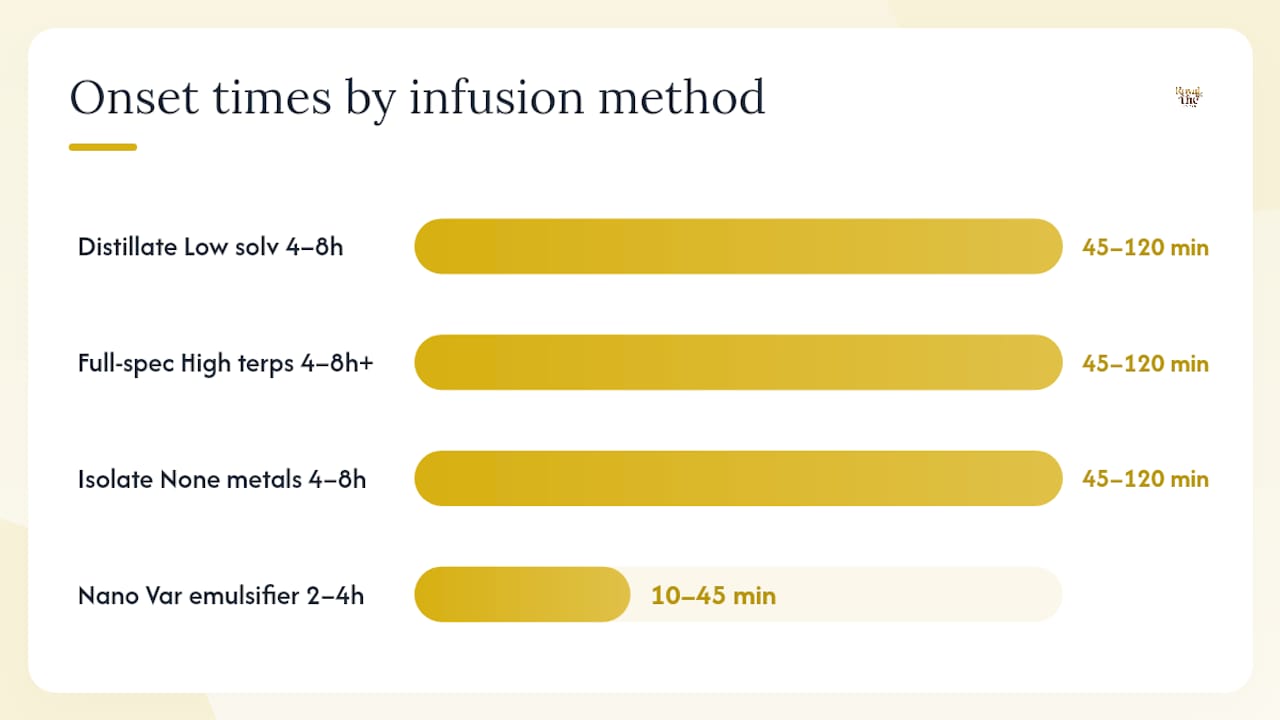
Watch COAs for residual solvents (ethanol, butane, propane) and pesticide panels. A product that skips these panels on its COA is a product you should skip at checkout.
4. Dosing and safety: what the research actually recommends
Beginner guidance consistently points to 1–3 mg THC as the right starting dose. The problem is that most pre-packaged gummies contain 5–10 mg per piece, which means new users either need to cut pieces or choose microdose products specifically. A 10 mg piece is not a beginner dose, regardless of how it’s packaged.
The pharmacological reason for caution is first-pass metabolism. When you eat a gummy, THC is absorbed through the gut and processed by the liver before entering the bloodstream. Research on cannabinoid pharmacokinetics shows this produces a slower onset (often 45–120 minutes) and typically stronger, longer-lasting effects than inhalation. The liver converts delta-9 THC into 11-hydroxy-THC, a metabolite that crosses the blood-brain barrier more readily. That’s why edibles hit harder and last longer than a comparable inhaled dose. You can compare that experience directly with inhalation methods at vaping vs. smoking cannabis.
| Experience Level | Starting Dose | Typical Onset | Typical Duration |
|---|---|---|---|
| Beginner | 1–3 mg THC | 45–120 min | 4–8 hrs |
| Moderate | 2.5–5 mg THC | 45–120 min | 4–8+ hrs |
| Experienced | 5–10 mg or more THC | 45–120 min | up to 8+ hrs |
Common side effects include anxiety, paranoia, nausea, dizziness, dry mouth, and over-intoxication (sometimes called “greening out”). These are dose-dependent and more likely when users take too much, redose before the first dose peaks, or mix with alcohol or other sedatives.
Storage and shelf life:
- Store in a cool, dry, airtight container away from direct light
- Keep out of reach of children and pets at all times
- Gelatin-based gummies typically last 6–12 months; pectin-based gummies may degrade slightly faster in heat or humidity
- Check the expiry date on the package and the batch number against the COA
Warning: Accidental ingestion by children and pets is a serious risk. Public health guidance emphasizes that gummies look identical to regular candy. Store them in child-resistant, clearly labeled packaging. Never mix THC gummies with alcohol or sedating medications.
5. Onset and duration: standard edibles vs. fast-acting formulations
Standard gummies typically begin working after a delay and effects last several hours. Fast-acting nanoemulsion gummies can onset faster and often have shorter duration, sometimes just a few hours. That shorter window is appealing for predictability, but it also creates a real risk of stacking doses. Someone who doesn’t feel effects at the 30-minute mark may take a second piece, only to have both hit simultaneously.
The biological explanation: standard gummies rely on fat-soluble absorption through the digestive tract, which is slow and variable. Nanoemulsions break cannabinoids into tiny water-compatible droplets that absorb more rapidly through the gut lining. PubMed research on oral cannabinoid formulations confirms this mechanism produces meaningfully faster onset.
| Product Type | Expected Onset | Expected Duration | Notes |
|---|---|---|---|
| Standard distillate gummy | 45–120 min | 4–8 hrs | Food slows onset further |
| Full-spectrum gummy | 45–120 min | 4–8+ hrs | Terpenes may intensify effects |
| Nanoemulsion / fast-acting | 10–45 min | 2–4 hrs | Risk of dose-stacking |
| Sublingual tincture (for comparison) | 15–45 min | 3–6 hrs | Not a gummy; included for reference |
Practical timing tips:
- For sleep: take a standard gummy 90–120 minutes before your target sleep time
- For a daytime event: fast-acting formulations give you more control over timing, but start with a lower dose
- On an empty stomach, onset is faster and effects can feel stronger; a light meal beforehand smooths the curve
- Never redose within 2 hours of the first piece, regardless of whether you feel anything yet
Red flags for unusually intense or prolonged effects:
- Effects lasting beyond 10–12 hours may indicate a higher-than-labeled dose
- Extreme anxiety, rapid heart rate, or confusion warrants moving to a calm environment, staying hydrated, and seeking medical help if symptoms escalate
- Mixing with alcohol dramatically amplifies intoxication and extends duration
6. How to read labels and COAs before you buy
A Certificate of Analysis is the single most useful document a gummy brand can provide. It’s a third-party lab report that verifies what’s actually in the product. Here’s what to check.
On the label itself:
- Per-piece mg THC (not just total package mg)
- THC/CBD ratio if applicable
- Full ingredient list including allergens (gelatin, tree nuts, soy, gluten)
- Manufacturing date and expiry date
- Batch number that matches the COA
- QR code or URL linking directly to the lab report
On the COA:
- Cannabinoid potency panel: confirms THC and CBD content per piece match the label. Acceptable variance is typically ±10–15% from the stated amount.
- Terpene profile: useful for predicting the character of effects; more informative than strain names alone
- Residual solvents: should show non-detectable or below action limits for ethanol, butane, propane, and other extraction solvents
- Pesticides: should be non-detectable for all regulated compounds
- Heavy metals: lead, arsenic, cadmium, and mercury should all be below action limits
- Microbial contaminants: total yeast, mold, and pathogen counts should be within safe limits
Red flags that should stop a purchase:
- No COA available, or a COA with no batch number linking it to the specific product
- Potency listed only as a total package figure with no per-piece breakdown
- COA dated more than 12 months ago
- Missing solvent, pesticide, or heavy metal panels
- Vague claims like “lab-tested” with no actual report accessible
- Unlicensed supplier with no verifiable business address
Understanding why lab-tested products matter goes beyond gummies. The same principles apply across all THC formats.
7. Legal and health considerations in the United States
Legality for THC gummies in the US depends on which cannabinoid is in the product and which state you’re in. Delta-9 THC remains federally controlled under Schedule I, but adult-use legalization in many states permits purchase and possession for adults 21 and older. Medical cannabis states often set the age at 18 with a valid patient card. State law governs what you can legally buy, possess, and consume, so confirm your state’s current rules before purchasing.
Delta-8 THC and other homologues are a separate issue. Cleveland Clinic’s overview of delta-8 notes that these compounds occupy a regulatory gray area, with legality and testing standards varying significantly across states. Some states have explicitly banned delta-8; others have no specific rules. Products labeled with delta-8, delta-10, HHC, or THCO deserve extra scrutiny on the COA because testing standards for these compounds are less consistent than for delta-9.
Consumer cautions for novel cannabinoids:
- Verify the specific cannabinoid is legal in your state before purchasing
- Demand a COA that includes a panel specifically for the labeled cannabinoid, not just delta-9 THC
- Be skeptical of products that claim to be “federally legal” without specifying the cannabinoid and its source
- Novel cannabinoids may have different potency curves and side-effect profiles than delta-9 THC
Health cautions: people who are pregnant or nursing, those taking medications that interact with CYP450 liver enzymes (including many antidepressants, blood thinners, and anticonvulsants), and individuals with cardiac or psychiatric conditions should consult a clinician before using any THC product.
This article provides general information, not legal or medical advice. Confirm current rules with your state’s cannabis regulatory authority or a qualified professional.
8. Practical selection guide: match the gummy to your goal
The fastest way to choose is to start with your goal, then work backward through formulation, potency, and onset profile.
Goal-to-formulation map:
- Sleep: THC+CBN blend or high-myrcene full-spectrum indica-leaning gummy, standard onset (take 90 minutes before bed), 5–10 mg for experienced users or 2.5–5 mg for beginners
- Daytime mood lift: sativa-leaning or hybrid gummy with limonene-forward terpene profile, low-to-standard dose, fast-acting formulation if timing precision matters
- Anxiety or stress relief without intensity: 1:1 THC:CBD balanced formula, microdose to low-dose range, standard onset
- Microdosing for function: 1–2.5 mg THC-only or 1:1 product, standard onset, gelatin or pectin base depending on dietary preference
- Strong recreational effects: high-potency THC-dominant gummy, full-spectrum or live-resin infusion, experienced users only
Buying checklist:
- Per-piece potency clearly stated on the label
- COA available with batch number matching the product
- Terpene listing on COA if strain character matters to you
- Base ingredient (gelatin vs. vegan pectin) confirmed
- Expiry date and manufacturing date visible
- Vendor has a clear return or quality policy
Red flags for online orders:
- No batch number or COA link on the product page
- Potency claims that seem unusually high for the price point
- No ingredient list or allergen disclosure
- Customer reviews mentioning inconsistent effects batch-to-batch
- Packaging that mimics commercial candy brands (a public health and legal concern)
Pro Tip: If you’re unsure where to start, the THC Gummy Dosage Guide at Thcvapesuk walks through first-session steps, including how to cut a standard 10 mg piece and how to track your response over multiple sessions. Beginners and returning users after a tolerance break should treat themselves as first-timers.
Key Takeaways
THC gummies fall into distinct categories by cannabinoid profile, infusion method, and delivery technology, and matching those categories to your goal is the most reliable way to get the experience you’re after.
| Point | Details |
|---|---|
| Start with 1–3 mg | Beginner dose per Chatelaine guidance; most packaged gummies are 5–10 mg per piece, so cut pieces or buy microdose products. |
| COA is non-negotiable | Verify per-piece potency, residual solvents, pesticides, and heavy metals before every purchase. |
| Strain labels are cues, not guarantees | Terpene profiles on the COA predict effects more reliably than sativa vs. indica vs. hybrid marketing labels. |
| Fast-acting gummies onset in 10–45 minutes | Nanoemulsion formulations shorten onset but also raise the risk of dose-stacking; never redose within 2 hours. |
| Thcvapesuk for lab-tested options | Thcvapesuk carries lab-tested gummies across potency levels with per-piece mg clearly listed and COAs available. |
The case for treating lab testing as the baseline, not the bonus
The conventional wisdom in cannabis retail treats a COA as a selling point, something brands mention to sound premium. That framing gets it backwards. A COA isn’t a differentiator. It’s the minimum acceptable standard for any product you put in your body.
What actually gets underestimated is how much the COA tells you beyond potency. The terpene panel on a full-spectrum gummy is more useful than any strain name. The residual solvent panel tells you whether the extraction was done cleanly. The pesticide panel matters especially for full-spectrum products, where everything in the plant concentrates into the extract. Skipping those panels isn’t a minor omission. It’s a meaningful gap in what you know about what you’re consuming.
The other thing worth saying plainly: the “start low and go slow” rule isn’t just for beginners. It applies to anyone trying a new product, a new brand, or returning after a break. Edible metabolism is variable enough that the same dose from two different manufacturers can feel noticeably different, even at identical per-piece mg. That variability is exactly why per-piece potency, COA verification, and a consistent first dose matter more than any marketing claim about strain or effect profile.
Thcvapesuk carries lab-tested gummies with clear potency per piece
Thcvapesuk stocks a curated range of THC gummies covering microdose, standard, and high-potency options, with both gelatin and vegan pectin bases available. Every product comes with lab-testing documentation, per-piece potency clearly listed, and COA access so you know exactly what you’re getting before it arrives.

For first-time buyers, the THC Gummy Dosage Guide at Thcvapesuk covers starting doses, how to read your response, and when to step up. Browse the full gummy category to filter by potency, formulation type, and brand, or use the dosage guide to figure out where to start before you buy.
Useful sources
The following sources informed this article. Each covers a specific aspect of THC gummy formulations, dosing, or safety.
| Source | What It Covers |
|---|---|
| Chatelaine: A Beginner’s Guide To Weed Gummies | Beginner dosing recommendations (1–3 mg start), standard package doses, and first-use guidance |
| NCBI PMC2731700: Cannabinoid Pharmacokinetics | First-pass metabolism, edible onset timing (45–120 min), and duration vs. inhalation |
| Public Health Institute at Denver Health: Marijuana Edible Facts | Public-health guidance on dose control, packaging safety, and accidental ingestion risks |
| PubMed PMID 33565878: Oral Cannabinoid Formulations and Absorption | Fast-acting nanoemulsion technology and shortened onset times |
| Harvard Health: Cannabidiol (CBD) | CBD’s non-intoxicating nature and its modulating effect on THC in 1:1 formulas |
| Cleveland Clinic: What Is Delta-8? | Delta-8 regulatory gray area, state variability, and testing inconsistencies |
| Biology Insights: What Are Hybrid Gummies Good For? | Limits of strain labeling, terpene contributions, and hybrid effects |
