


Vaping generally reduces your exposure to combustion toxins compared with smoking cannabis, but it often delivers higher THC concentrations per inhalation and introduces its own device and product risks. That is the short answer; the longer one matters more.
Peer-reviewed evidence confirms that vaporizers can reduce carbon monoxide and many pyrolytic toxins produced when cannabis burns. A controlled crossover trial published in JAMA Network Open found that vaporized cannabis produced higher peak whole-blood THC and stronger subjective effects than smoked cannabis at the same nominal dose. And a CCSA cardiovascular report links cannabis smoking to elevated risk for serious cardiac events in susceptible individuals, a caution that extends to vaping given shared acute cardiovascular responses.
The quick picture:
- Lower combustion toxin exposure: Vaping avoids most pyrolysis by-products (tar, carbon monoxide, polycyclic aromatic hydrocarbons).
- Higher dose efficiency: Vaporizers extract cannabinoids more efficiently, meaning more THC is delivered to your bloodstream from the same amount of cannabis.
- Device and product risk: Unregulated cartridges, cutting agents, and battery failures introduce hazards absent from dried-flower smoking.
- UK legal status: THC and THC-containing vape products are illegal in the UK under the Misuse of Drugs Act 1971. Neither method is legally sanctioned for recreational use.
Key finding: Vaporization reduces smoke-based toxin exposure but does not eliminate risk. Higher cannabinoid delivery efficiency and unregulated product contamination are the two most clinically significant hazards specific to vaping.
Table of Contents
- How does vaping cannabis actually differ from smoking it?
- What happens to your body in the first hour: onset, peak, and duration
- Long-term respiratory risks: what the evidence actually shows
- Cardiovascular and systemic risks: what inhaled cannabis does to your heart
- Device and product safety: contaminants, additives, and EVALI
- Potency and dosing: why vaping raises overconsumption risk
- How UK young people perceive vaping vs smoking cannabis
- What is the legal status of cannabis vaping in the UK?
- Harm reduction: practical steps if you choose to inhale cannabis
- How we evaluated the evidence
- Does vaping cannabis harm the environment less than smoking it?
- How vaping and smoking cannabis affect your mouth and throat
- Key Takeaways
- The evidence points one way, but the context matters more than the headline
- Lab-tested THC vapes from Thcvapesuk: what informed choice looks like
- Useful sources and further reading
How does vaping cannabis actually differ from smoking it?
The difference starts with temperature. Smoking combusts cannabis at roughly 600–900°C, a range that triggers pyrolysis: the thermal breakdown of organic material into hundreds of chemical by-products. Vaporizers operate at approximately 160–230°C, which is hot enough to decarboxylate cannabinoids and release them as aerosol without triggering full combustion. That gap in temperature is why smoke and vapor have such different chemical profiles.
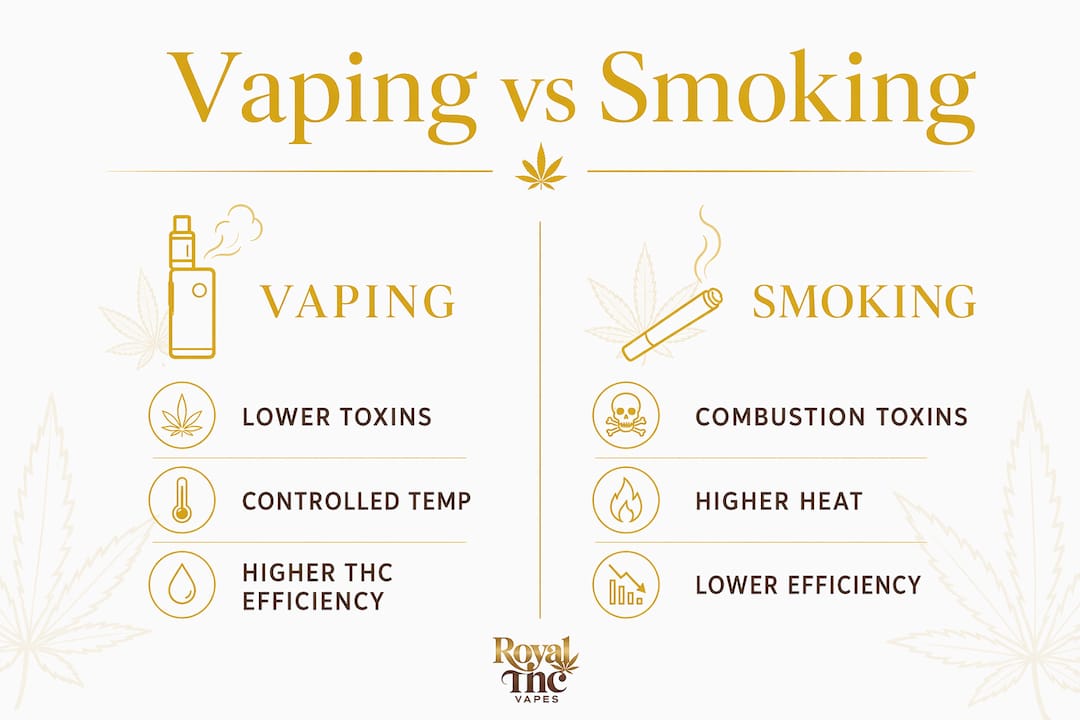
Cannabis smoke contains tar, carbon monoxide, ammonia, and polycyclic aromatic hydrocarbons (PAHs), the same classes of toxins produced when tobacco burns. Vapor contains far fewer of these combustion by-products. But laboratory comparisons show that vapor is not chemically inert: it carries unique constituents not found in smoke, and specific vaporization temperatures alter aerosol chemistry in ways that can affect cellular metabolic pathways. Fewer chemicals does not mean zero chemicals.
Device type matters enormously here. Dry-herb vaporizers heat whole cannabis flower and produce the most studied, relatively better-characterized aerosol. Concentrate pens and liquid-based cartridges heat oils, waxes, or distillates, and the aerosol chemistry depends heavily on what is in the liquid, including solvents, carrier oils, and any adulterants. The product format changes your exposure profile as much as the device does.
Clinical note: Vaporization “significantly or completely reduces levels of combustion toxins compared with smoked cannabis,” according to a 2025 clinical review in Cannabis and Cannabinoid Research, but the authors emphasize that device quality and product sourcing remain the primary variables determining actual risk.
Pro Tip: If you are comparing methods for harm-reduction purposes, dry-herb vaporizers using lab-tested flower are the format with the most evidence behind them. Concentrate cartridges from unverified sources sit at the opposite end of the risk spectrum.
What happens to your body in the first hour: onset, peak, and duration
Both vaping and smoking deliver THC through the lungs into the bloodstream within seconds. Effects typically begin within minutes and peak around 10–15 minutes after inhalation. That rapid onset is what distinguishes inhaled cannabis from edibles, which take 30 minutes to 2 hours to act.
The critical difference is magnitude, not timing. The JAMA crossover trial found that vaporized cannabis produced higher peak whole-blood THC and significantly stronger subjective effects than smoked cannabis at identical doses. For an infrequent user, that gap can be the difference between a manageable experience and an acutely distressing one. Experienced users with higher tolerance may notice it less, but the pharmacokinetic reality does not change.
A practical timeline for inhaled cannabis:
- 0–2 minutes: THC enters the bloodstream via the lungs; initial effects begin.
- 5–15 minutes: Peak blood THC concentration; strongest subjective effects.
- 1–3 hours: Effects taper; residual impairment may persist beyond subjective awareness.
- Up to 24 hours: Some cognitive effects (reaction time, working memory) can persist at low levels.
The driving implication is direct. Impairment can outlast the feeling of being high, which means waiting several hours after use before operating a vehicle is not overcautious. It is what the evidence supports.
Pro Tip: For a first vaping session, take one inhalation, then wait a full 15 minutes before deciding whether to take another. Vaping’s higher delivery efficiency makes redosing too soon the most common route to an overwhelming experience.
Long-term respiratory risks: what the evidence actually shows
Smoking cannabis is associated with chronic cough, increased phlegm production, and more frequent bronchitis episodes. One clinical review notes that cannabis smoke delivers a fourfold greater amount of tar per inhalation compared with tobacco smoke. There is also evidence suggesting a possible association with COPD development and worsened lung function, though the data here are less definitive and confounded by tobacco co-use in many study populations.
Switching to vaporization reduces these markers in short-term studies. Research published in PMC confirms that vaporizer use is associated with fewer self-reported respiratory symptoms like chronic cough and phlegm. The caveat is that “short-term” is doing a lot of work in that sentence. Long-term randomized controlled trials on vaping cannabis do not exist. Most evidence comes from cohort studies, cross-sectional surveys, and controlled pharmacokinetic trials, none of which can fully isolate vaping’s chronic effects from confounders like tobacco use, product type, and frequency of consumption.
| Respiratory marker | Cannabis smoking | Cannabis vaping |
|---|---|---|
| Combustion toxin exposure | High (tar, CO, PAHs) | Substantially reduced |
| Chronic cough / phlegm | Associated in multiple studies | Reduced in switchers (short-term data) |
| Bronchitis episodes | Elevated frequency | Fewer reported in switchers |
| Lung cancer risk | Current evidence does not confirm association | Insufficient long-term data |
| Study quality available | Cohort, cross-sectional, some RCTs | Mostly short-term; no long-term RCTs |
Limitation: Device heterogeneity, product variability, and tobacco co-use confound nearly every study in this space. A finding from a dry-herb vaporizer trial does not automatically apply to concentrate cartridges, and vice versa.
The honest summary: vaping is likely better for your lungs than smoking, based on the mechanism and available short-term data. But “likely better” is not the same as “safe,” and the absence of long-term trial data means that conclusion carries real uncertainty.
Cardiovascular and systemic risks: what inhaled cannabis does to your heart
Both vaping and smoking cannabis produce acute increases in heart rate, sometimes substantially. Decreased blood pressure can also occur, which in some individuals causes dizziness or fainting. These acute responses are pharmacological, driven by THC itself, and present regardless of whether you smoke or vape.

The more serious concern is chronic and event-based risk. CCSA evidence links cannabis smoking to elevated risk for myocardial infarction in certain populations, particularly those with preexisting cardiovascular disease. Stroke and other vascular events are also flagged in the literature. Whether vaping carries equivalent cardiovascular risk is not yet established, but because the acute hemodynamic effects are driven by THC rather than combustion products, the risk does not simply disappear by switching delivery method.
Populations with elevated cardiovascular risk from cannabis use:
- People with diagnosed coronary artery disease or prior myocardial infarction
- Older adults (cardiovascular reserve decreases with age)
- People with uncontrolled hypertension or arrhythmias
- Anyone combining cannabis with stimulants or other cardiovascular-active substances
Warning: If you experience chest pain, palpitations, shortness of breath, or sudden dizziness during or after cannabis use, stop immediately and seek medical attention. These symptoms warrant clinical evaluation regardless of how you consumed.
Device and product safety: contaminants, additives, and EVALI
The EVALI outbreak in 2019 and 2020 put vaping-associated lung injury on the map. Investigations identified a strong association between EVALI cases and vitamin E acetate, a cutting agent used in illicit THC-containing liquids to bulk out cartridges cheaply. PMC research confirms that EVALI was linked to unregulated THC liquids and additives rather than regulated, lab-tested products. Regulated supply chains reduce but do not eliminate this risk.
Beyond vitamin E acetate, contamination vectors in vape products include heavy metals leaching from poorly manufactured heating coils (lead, nickel, chromium), residual solvents from extraction processes, and pesticide residues in unverified cannabis inputs. Dry-herb vaporizers using tested flower sidestep most of these concerns, but concentrate cartridges from unknown sources do not.
EVALI lesson: The outbreak was not caused by vaping cannabis per se. It was caused by unregulated products with undisclosed additives. The distinction matters for harm reduction: product sourcing is as important as device choice.
Practical checklist for safer product selection:
- Verify a batch-specific lab report (Certificate of Analysis) before purchasing any cartridge
- Confirm the lab report tests for heavy metals, residual solvents, and pesticides, not just cannabinoid potency
- Avoid cartridges with no ingredient disclosure or from sources with no verifiable supply chain
- Check that the hardware is from a reputable manufacturer with known coil materials
- Read why lab-tested carts matter before making any purchasing decision
Pro Tip: Battery safety is underrated. Use the charger supplied with your device, never charge overnight or unattended, and replace any battery that shows swelling, heat during charging, or physical damage. Lithium battery failures in vape devices can cause fires.
Potency and dosing: why vaping raises overconsumption risk
Vaporizers are more efficient at extracting cannabinoids than combustion. Significant THC is lost in sidestream smoke and through pyrolysis when cannabis burns. Vaporizers are designed to prevent that loss, which means a higher proportion of the available THC reaches your lungs and bloodstream. At the same nominal dose, you get more THC from a vaporizer than from a joint.
Concentrate cartridges amplify this further. Dried flower typically contains 15–25% THC by weight. Distillate cartridges commonly run 70–90% THC, and some live resin or liquid diamond products sit even higher. The difference in concentration between a joint and a high-potency cartridge is not incremental. It is categorical.
| Product type | Typical THC concentration | Relative blood-THC risk |
|---|---|---|
| Dried cannabis flower | 15–25% | Baseline reference |
| Vaporized dried flower | 15–25% (more efficiently extracted) | Moderate (higher than smoking same flower) |
| Distillate cartridge | 70–90% | High |
| Live resin / liquid diamond cart | 70–90% | High to very high |
| Hash / concentrate (dab) | 70–90% | Very high |
For infrequent users and anyone new to vaping, the practical implication is straightforward: start with the lowest available potency, take one inhalation, and wait 15 minutes. The distillate vs live resin distinction also matters here, since live resin products retain more of the original terpene and cannabinoid profile, which can affect both the character and intensity of effects.
Youth and infrequent users face the greatest acute risk from high-potency vape formats. Tolerance develops with regular use, but a naive user hitting a 90% distillate cartridge is in genuinely different territory than someone smoking moderate-potency flower.
Pro Tip: If you are switching from smoking to vaping, treat yourself as a first-time user for the first few sessions. Your tolerance to smoked cannabis does not map directly onto vaporized concentrates.
How UK young people perceive vaping vs smoking cannabis
Perception data consistently shows that a substantial proportion of young people view vaping cannabis as less harmful than smoking it. That perception is not entirely wrong on the respiratory toxin question, but it tends to flatten the real risk picture: higher potency delivery, product contamination, and dependence risk do not disappear because combustion is removed.
Public health concern: When perceived harm decreases, uptake tends to increase. If young people believe vaping cannabis is essentially safe, the harm-reduction framing that motivates adults to switch from smoking can instead motivate non-users to start.
UK surveillance data on cannabis vaping among young people reflects this dynamic. The normalization of nicotine vaping has created a cultural context in which vaping devices are familiar and socially acceptable, lowering the psychological barrier to trying THC-containing products. The devices look identical. The behavior looks identical. The chemical exposure is not.
From a policy standpoint, this creates a genuine tension: harm-reduction messaging aimed at adult smokers can inadvertently signal to young non-users that vaping cannabis is low-risk. Public health bodies in the UK, including the NHS and the Advisory Council on the Misuse of Drugs (ACMD), have flagged youth initiation as a primary concern in cannabis policy discussions.
What is the legal status of cannabis vaping in the UK?
THC is a Class B controlled substance under the Misuse of Drugs Act 1971. Possession carries a penalty of up to five years in prison; supply carries up to 14 years. THC-containing vape products, cartridges, and disposables are illegal for recreational sale and purchase in the UK, full stop. There is no licensed recreational cannabis market.
| Product | UK legal status | Notes |
|---|---|---|
| THC (any form) | Class B controlled substance | Possession and supply both criminal offenses |
| THC vape cartridges / disposables | Illegal | Unregulated; no quality or safety standards apply |
| CBD products (low THC) | Legal (with conditions) | Must meet Novel Food or cosmetic regulations |
| Nicotine-only vapes | Legal (regulated) | Subject to MHRA and Tobacco Products Directive rules |
| Medical cannabis (prescribed) | Legal for specific patients | Requires specialist prescription; very limited availability |
Policy implication: Because THC vapes are illegal and unregulated in the UK, the primary harm-reduction benefit of vaping (regulated product quality and lab testing) is structurally harder to realize. Unregulated supply chains increase contamination risk significantly compared with markets where cannabis is legally regulated.
For the most current guidance, the UK government’s drug penalties page and NHS drug information resources are the authoritative references. Anyone with questions about medical cannabis should speak with a licensed clinician, not a retailer.
This article provides general information only and is not a substitute for legal or medical advice. Confirm current rules with official UK government sources or a qualified professional for your specific situation.
Harm reduction: practical steps if you choose to inhale cannabis
If you decide to use cannabis by inhalation, these steps reduce risk in a meaningful, evidence-informed way:
- Choose dry-herb vaporization over unknown concentrates. Dried flower has a better-characterized risk profile than unverified cartridges.
- Verify lab reports before purchasing any cartridge. Confirm testing for potency, heavy metals, residual solvents, and pesticides.
- Start with one inhalation and wait 15 minutes. This applies every time you use a new product or a new device.
- Avoid sharing devices. Shared mouthpieces transmit respiratory pathogens.
- Do not drive for several hours after use. Impairment outlasts subjective effects.
- Check battery condition before every session. Damaged or swollen batteries are a fire risk.
- Use the disposable vape guide to evaluate hardware quality before committing to a product.
Red-flag symptoms that require medical review:
- Chest pain or tightness during or after use
- Persistent cough, shortness of breath, or coughing blood
- Rapid or irregular heartbeat
- Fever with respiratory symptoms (possible EVALI presentation)
- Severe anxiety, paranoia, or psychotic symptoms
Population-specific cautions:
- Pregnancy: No safe level of cannabis use in pregnancy has been established. Avoid entirely.
- Under 25: The developing brain is particularly vulnerable to cannabis-related harm; delay use as long as possible.
- Cardiovascular disease: Consult a clinician before any cannabis use.
- Mental health history: Cannabis, especially high-THC products, can precipitate or worsen psychotic symptoms.
How we evaluated the evidence
This article prioritizes peer-reviewed studies, systematic reviews, controlled trials, and government health reports. Where UK-specific evidence was available, it was flagged explicitly; where it was not, out-of-market data (primarily Canadian and US sources) was attributed to its origin. The date range for sources spans 2019–2025, with preference for the most recent available evidence.
Methodological note: The evidence base for cannabis vaping is younger and thinner than for tobacco. Most studies are short-term, use heterogeneous devices and products, and cannot fully control for tobacco co-use. Findings from dry-herb vaporizer studies should not be generalized to concentrate cartridges without caution.
Key limitations readers should factor in:
- No long-term randomized controlled trials on chronic vaping outcomes exist.
- Device and product heterogeneity means a finding from one vaporizer type may not apply to another.
- Tobacco co-use confounds respiratory outcome data in many studies.
- UK-specific surveillance data on cannabis vaping is limited compared with North American datasets.
- Illicit market product composition is unknown and variable, making contamination risk hard to quantify precisely.
| Source type | Examples used | Strength |
|---|---|---|
| Controlled crossover RCT | JAMA Network Open (2019) | High for pharmacokinetics |
| Systematic review / PMC | PMC8975973 | High for respiratory outcomes |
| Government health report | CCSA (2020), Health Canada | Moderate-high for policy and CV risk |
| Clinical practice review | Cannabis and Cannabinoid Research (2025) | High for clinical application |
| Laboratory / toxicology | American Journal of Physiology (2025) | High for chemical characterization |
Does vaping cannabis harm the environment less than smoking it?
Secondhand smoke from cannabis contains the same combustion by-products as firsthand smoke: carbon monoxide, PAHs, and particulate matter. Bystanders in enclosed spaces where cannabis is smoked are exposed to measurable levels of these toxins. Vaping produces aerosol rather than smoke, and secondhand aerosol exposure is generally lower in combustion by-products, though not zero. Particulate matter from vapor can still affect air quality in poorly ventilated spaces.
From a broader environmental perspective, vaping hardware introduces electronic waste that smoking does not. Disposable vape pens contain lithium batteries, heating elements, and plastic components that require specific disposal pathways. A single-use cartridge or disposable pen that ends up in general waste contributes to heavy metal contamination in landfill. Reusable vaporizers with replaceable cartridges reduce this footprint compared with disposables, but the waste question is real and often overlooked in harm-reduction discussions.
Cannabis cultivation itself carries a significant environmental footprint regardless of consumption method, particularly for indoor-grown product. The method of consumption does not change upstream agricultural impact.
How vaping and smoking cannabis affect your mouth and throat
Smoking cannabis exposes the oral mucosa, gums, and throat to combustion products at high temperatures. Chronic cannabis smokers show higher rates of gum disease, oral mucosal lesions, and uvular changes compared with non-smokers. The heat and particulate matter from smoke cause direct thermal and chemical injury to the tissues lining the mouth and throat.
Vaping operates at lower temperatures, which reduces direct thermal injury. However, the aerosol from vape devices is not neutral. Propylene glycol and vegetable glycerin, common carrier agents in some cannabis liquids, can cause dry mouth and throat irritation with regular use. Dry mouth, in turn, reduces saliva production, and saliva is the mouth’s primary defense against bacterial overgrowth and tooth decay. Regular vapers who experience persistent dry mouth face elevated cavity and gum disease risk through this indirect pathway.
Terpenes and flavoring compounds in cannabis aerosol can also irritate mucosal membranes, particularly at higher vaporization temperatures. The terpene profile of a product affects more than flavor; it affects the character of mucosal exposure with each inhalation. Dry-herb vaporizers at moderate temperature settings tend to produce less mucosal irritation than high-temperature concentrate sessions, though individual sensitivity varies.
Key Takeaways
Vaping cannabis reduces combustion toxin exposure compared with smoking, but higher THC delivery efficiency, unregulated product contamination, and the UK’s illegal supply chain mean it carries its own serious risks that should not be minimized.
| Point | Details |
|---|---|
| Respiratory toxin advantage | Vaping avoids most combustion by-products (tar, CO, PAHs) associated with chronic cough and bronchitis. |
| Higher dose per inhalation | Vaporizers extract significantly more THC than smoking the same flower; concentrate carts amplify this further. |
| Product safety is the variable | EVALI was caused by unregulated additives, not vaping itself; lab-tested products reduce but do not eliminate risk. |
| UK legal status | THC and THC vapes are Class B controlled substances; no legal recreational supply chain exists in the UK. |
| Thcvapesuk product approach | Thcvapesuk supplies lab-tested THC vape products with batch-level Certificates of Analysis for informed product selection. |
The evidence points one way, but the context matters more than the headline
The conventional framing of this debate, “vaping is safer than smoking,” is technically defensible on the respiratory toxin question and misleading on almost everything else. It treats a relative reduction in one harm category as a general safety endorsement, which it is not.
What the evidence actually supports is narrower: vaping dried cannabis flower using a quality device reduces exposure to combustion by-products compared with smoking. That is a real and clinically meaningful difference for someone who is already smoking cannabis regularly and cannot or will not stop. For that person, switching to a dry-herb vaporizer with lab-tested flower is a genuine harm-reduction step.
The picture changes when you introduce concentrate cartridges, unverified supply chains, infrequent or young users, and the UK’s unregulated market. Higher potency delivery into a naive system, combined with products that have no quality oversight, can produce outcomes worse than moderate smoking. The harm-reduction benefit of vaping is conditional on product quality and user knowledge, not inherent to the act of vaping itself.
The other thing the headline misses: the cardiovascular risk does not track with combustion. It tracks with THC. Switching from smoking to vaping does not meaningfully reduce acute cardiac stress for someone with preexisting heart disease. That distinction matters clinically and is routinely lost in popular coverage of this topic.
Lab-tested THC vapes from Thcvapesuk: what informed choice looks like
The harm-reduction case for vaping over smoking depends entirely on product quality. An unverified cartridge from an unknown source negates the respiratory benefit and adds contamination risk. That is the gap Thcvapesuk addresses directly.

Thcvapesuk stocks lab-tested THC vape products from verified brands including Dabwoods, Stiiizy, Muha Meds, Raw Garden, and Packman, with batch-level Certificates of Analysis available so you know exactly what is in the cartridge before you use it. Products ship discreetly across the UK. The range covers sativa, indica, and hybrid options across multiple potency levels, which means you can apply the “start low” dosing principle with products that actually tell you what the starting point is. Browse the full selection at Thcvapesuk and check the current specials at thcvapesuk.com/specials.
Useful sources and further reading
On using these sources: The peer-reviewed studies below are the primary evidence base for this article’s health and pharmacokinetic claims. Government sources are authoritative for legal and policy context. Readers seeking clinical guidance should consult an NHS clinician or specialist.
| Source | Type | Why it matters |
|---|---|---|
| PMC: Are vaporizers a lower-risk alternative? | Systematic review | Core evidence on respiratory outcomes and EVALI |
| JAMA Network Open crossover trial | RCT | Pharmacokinetics: blood THC and subjective effects, vaping vs smoking |
| CCSA cardiovascular report | Government health report | Cardiovascular risk evidence and population data |
| MacCallum, Drug and Alcohol Review | Clinical review | Device types, temperatures, and harm-reduction guidance |
| American Journal of Physiology | Laboratory / toxicology | Chemical characterization of smoke vs vapor |
| Health Canada: accessories for inhalation | Government guidance | Practical sourcing and device safety recommendations |
| CDC: Cannabis health effects | Government health authority | Lung, cardiovascular, and general health effects overview |
| NHS drug information | UK health authority | UK-specific health guidance and clinical signposting |
| UK gov: drug penalties | UK legal authority | Current penalties for possession and supply |
