


Yes, THC vape cartridges produce a smell, but it’s considerably milder and shorter-lived than smoked cannabis. The odor comes from terpenes, the aromatic compounds naturally present in cannabis oil, which vaporize when heated. No combustion means no burnt plant matter, no tar, and no lingering smoke cloud. What you get instead is a lighter, often flavor-driven scent that typically clears within minutes in a ventilated space. For anyone wondering whether vaping is completely odorless, the honest answer is no. But for anyone comparing it to smoking flower, the difference in detectability is significant. Thcvapesuk carries lab-tested THC carts and disposables across the full spectrum, from low-odor distillates to terpene-rich live resin options.
When smell is most noticeable:
- During and immediately after an active exhale, when aerosol concentration is highest
- In small, enclosed spaces with little airflow (bathrooms, cars, closets)
How long it typically lingers:
- Ventilated rooms: a few minutes
- Small enclosed spaces: 5–20 minutes or longer with repeated draws
Pro Tip: Choose a THC disposable vape with a lower output setting if discretion is your first priority. Smaller clouds mean less aerosol in the air and a faster dissipation time.
Key Takeaways
THC vape carts do produce a smell, but distillate carts in ventilated spaces are far less detectable than smoked cannabis and typically clear within minutes.
| Point | Details |
|---|---|
| Carts do smell | Terpenes create odor; distillate carts are faintest, live resin carts are strongest. |
| Linger time varies | Ventilated rooms clear in 2–5 minutes; enclosed spaces can hold odor for 5–20 minutes or more. |
| Clothes and hair | Vape scent rarely clings persistently; laundering or airing out typically removes it. |
| Top mitigation steps | Ventilation first, then small draws and a sploof; activated carbon beats air freshener. |
| Choose lab-tested products | Verified carts avoid off-smells and contamination risks from black-market alternatives. |
Table of Contents
- Why does vapor smell different from smoke?
- Which cartridge types smell the most?
- Where does the smell go, and how long does it last?
- How to minimize or remove cart smell
- Are carts actually smell-proof? Common myths
- Health, secondhand exposure, and legal reminders
- What labs and authoritative sources say about vape odor
- The real tradeoff nobody talks about
- Sources
Why does vapor smell different from smoke?
Combustion is the core difference. When you light cannabis flower, you burn plant cellulose, chlorophyll, and dozens of organic compounds alongside the cannabinoids and terpenes you actually want. That process produces tar, carbon byproducts, and a dense, sticky smoke that clings to fabric and surfaces. Vaping heats oil to a temperature below combustion, so you’re releasing terpenes and cannabinoids as vapor without generating those persistent byproducts.
Vape aerosol typically smells lighter and disappears faster than cigarette smoke, with ventilation usually clearing it within minutes under normal conditions. The scent profile is largely determined by the terpene content of the oil and any added flavorings, not by burnt plant matter.
A few factors that shape how detectable vapor is:
- Terpene concentration: Higher terpene content means a stronger, more recognizable cannabis aroma
- Temperature setting: Lower heat produces less visible vapor and a lighter scent; higher temps push more terpenes into the air
- Cloud volume: Bigger draws create denser aerosol that takes longer to disperse
- Ventilation: Open windows and fans are the single biggest variable in how fast the smell clears
Compared to smoking, vape odor is also less recognizable to people who aren’t familiar with cannabis. Smoke has a distinctive, universally known profile. Vapor, especially from flavored or distillate carts, often reads as a generic sweet or fruity smell rather than unmistakably weed.
Here’s a quick side-by-side on persistence:
- Smoked flower: Odor clings to hair, clothes, and upholstery; can linger for hours or days without washing
- Dry herb vaporizer: Noticeably weaker than smoke but still releases a full terpene profile; lingers 10–20 minutes in a room
- Live resin / full-spectrum cart: Moderate odor with a recognizable cannabis character; clears faster than dry herb
- Distillate cart: Lightest aroma, often described as barely noticeable; clears within minutes in most settings
Which cartridge types smell the most?
Odor intensity differs significantly by product type: distillate cartridges are usually the least aromatic, while live resin and dry-herb devices are the most noticeable. Here’s how the main categories stack up, from least to most detectable:
- Distillate carts (510-thread or pod): Highly refined oil with most terpenes removed during processing. The scent is faint and often indistinguishable from a generic flavored vape. Consumer reports frequently describe these as “practically odorless” compared to smoking, though that’s observational and varies by session length and room size.
- Flavored oil cartridges: Added terpenes and flavor compounds create a more noticeable scent. Sweet or dessert profiles (vanilla, berry, candy) can actually be more conspicuous in small spaces because the smell is unfamiliar and attention-grabbing.
- Live resin and full-spectrum carts: Preserve the plant’s original terpene profile, which means a richer, more recognizable cannabis aroma. These are the most flavorful option but also the least discreet. If you want to understand the flavor and potency tradeoffs, the distillate vs live resin breakdown is worth reading before you buy.
- Dry herb vaporizers: Not a cartridge, but worth the comparison. Full plant material releases the complete terpene spectrum. Smell is closest to smoking flower and lingers longest.
Device type also matters. A high-wattage 510 battery running at full power pushes more vapor per draw than a low-output pod system or a slim disposable. More vapor means more terpenes in the air and a slower dissipation.
A note on fake and black-market carts: Counterfeit cartridges often smell noticeably off, sometimes chemical or synthetic rather than cannabis-like. That’s a red flag for contamination, not just a quality issue. Lab-tested products from verified sources eliminate that risk. Always check for third-party testing before buying, and read why lab-tested THC carts matter if you’re unsure what to look for.
Where does the smell go, and how long does it last?
The short answer: vapor disperses faster than smoke, but it still goes somewhere. Where it ends up and how long it stays depends on the surface, the space, and how much you’ve vaped.
Typical linger times by setting:
- Ventilated room with open window or fan: 2–5 minutes
- Small enclosed room (no airflow): 10–20+ minutes
- Car cabin: 10–30 minutes without ventilation (car interiors concentrate odor due to small volume and recirculated air)
- Clothes and hair: brief mild scent after light exposure; usually gone within an hour without laundering
Vape scent generally does not cling to clothing as persistently as smoke. Brief exposure can leave a mild scent, but airing out or laundering typically removes it. That’s a meaningful difference from smoking, where a single session can saturate a jacket for days.
Surfaces matter too. Hard surfaces like painted walls, glass, and tile don’t trap terpene molecules the way porous materials do. Fabric, carpet, upholstery, and car seats absorb and re-emit odor, especially after repeated sessions. One vaping session in a well-ventilated room leaves almost no residue. Regular sessions in a small, poorly ventilated space build up over time.
| Device/Product Type | Ventilated Room | Small Enclosed Space | Clothes/Hair |
|---|---|---|---|
| Distillate cart | 1–5 minutes | 5–10 minutes | Minimal |
| Flavored oil cart | 2–5 minutes | 10–20 minutes | Light, brief |
| Live resin cart | 5–20 minutes | 10–30 minutes | Noticeable |
| Dry herb vaporizer | 10–20 minutes | 10–30 minutes | Moderate |
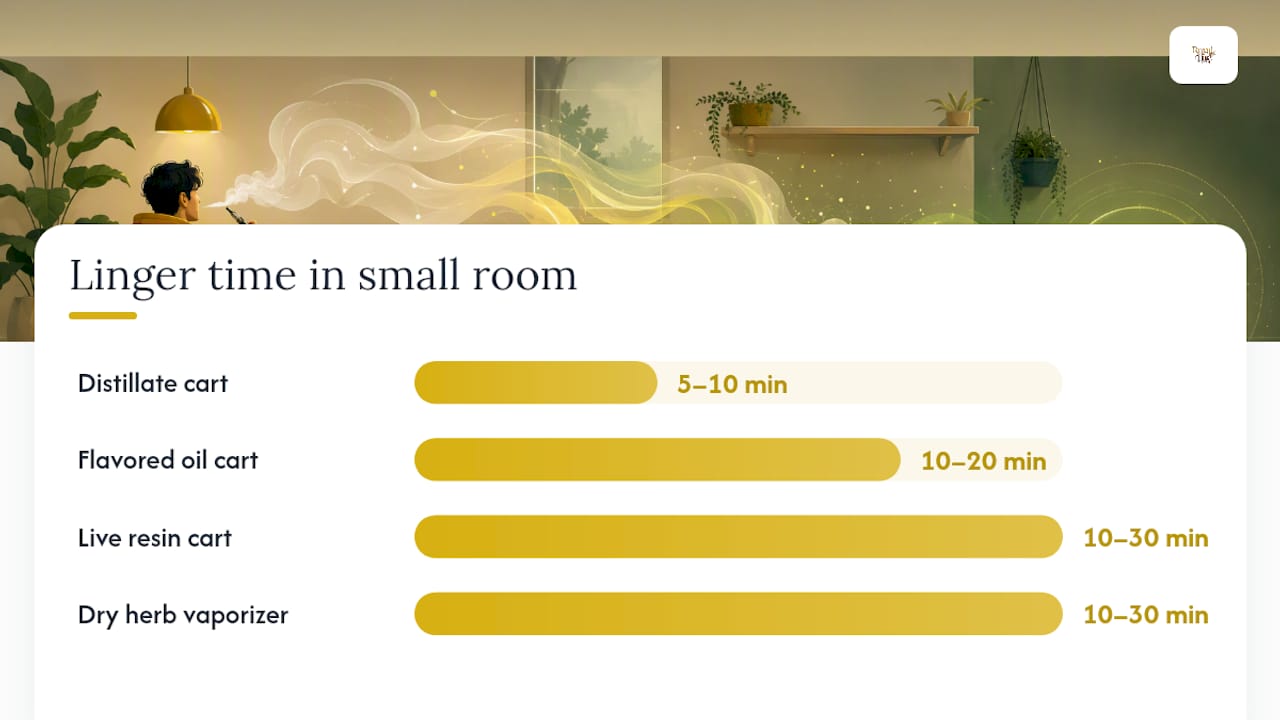
Vape odor can linger from roughly 5 to 20 minutes depending on device, formulation, and ventilation, with dab and wax devices tending toward the longer end of that range.
How to minimize or remove cart smell
Ventilation is the most effective immediate tactic, and it costs nothing. Open a window, point a fan outward, and exhale directly toward the airflow. That alone cuts detection risk more than any product or gadget.
Immediate tactics:
- Take smaller draws. Less vapor per exhale means less aerosol in the air.
- Exhale through a sploof (a tube packed with activated carbon or dryer sheets). It filters terpenes before they reach the room.
- Exhale outdoors or directly toward an open window with a fan pushing air outside.
- Use a HEPA or activated carbon air purifier. These actively filter terpene molecules rather than just masking them with fragrance.
Car-specific tactics:
- Switch your HVAC to fresh-air mode (not recirculation). Recirculation traps and concentrates odor inside the cabin.
- Keep windows cracked during and after a session.
- Place activated charcoal pouches or baking soda sachets under seats to absorb residual scent from upholstery.
- Wipe down hard surfaces (dashboard, door panels) with a damp cloth after heavy sessions.
Small enclosed spaces like car cabins concentrate vapor and scent; quick ventilation and activated carbon reduce odor and prevent fabric re-emission.
Home cleanup:
- Run ventilation during and after sessions, not just after.
- Launder any fabric that absorbed vapor regularly. Odor absorbers work better than air fresheners, which only add a competing scent on top of the existing one.
- Wipe down hard surfaces with a mild cleaner.
Product and device selection:
- Choose a smooth-hitting, low-output device for the most discreet experience.
- Distillate carts produce the least noticeable odor. If discretion matters more than flavor complexity, that’s the practical choice.
- Avoid heavily flavored dessert oils in sensitive settings. Sweet, candy-like smells stand out in enclosed spaces even when they’re not recognizably cannabis.
For a broader look at discreet inhalation options across product categories, this guide on discrete nicotine use covers useful tactics that translate directly to vaping discretion.
Pro Tip: Combine small draws, a sploof, and a fan pointed outward for the best results. Each tactic alone reduces odor; together, they cut detection risk substantially in most indoor settings.
Are carts actually smell-proof? Common myths
No. Vaping is not odorless, and any claim to the contrary is marketing, not chemistry. Terpenes are volatile aromatic compounds. When you heat them, they enter the air. That’s the whole mechanism behind aroma, and it applies whether you’re vaping cannabis oil or brewing coffee.
The “odorless” myth persists because distillate carts are genuinely much less noticeable than smoking. That gap is real and meaningful. But “much less noticeable” is not the same as undetectable.
Where the myths break down:
- “My cart doesn’t smell at all.” Distillates are faint, but in a quiet room with a sensitive nose nearby, they’re detectable. Session length and room size are the deciding variables.
- “Air freshener covers it completely.” Fragrance masking adds a competing smell on top of the existing one. Anyone with a trained or sensitive nose will detect both. Activated carbon absorbs; air freshener doesn’t.
- “Sploofs make vaping undetectable.” Sploofs reduce immediate odor significantly but aren’t foolproof, especially in small spaces or with repeated draws. Masking techniques can reduce noticeability but may not fully prevent detection around sensitive people.
- “Vaping indoors leaves no trace.” Repeated sessions in a poorly ventilated space build up terpene residue on soft surfaces over time. The smell becomes embedded in fabric and upholstery.
Realistic expectation: a single draw from a distillate cart near an open window in a large room is unlikely to be noticed by most people. A 30-minute session with a live resin cart in a small bathroom will be obvious. Know your setting and choose your product accordingly.
Health, secondhand exposure, and legal reminders
Exhaled vape aerosol is not the same as exhaled cigarette smoke in composition, but it’s not inert either. It contains terpenes, residual cannabinoids, and in some cases trace amounts of volatile organic compounds. In well-ventilated spaces, these disperse quickly and secondhand exposure is minimal. In small, enclosed spaces with repeated sessions, the concentration rises.
From a ventilation standpoint: the same tactics that reduce odor also reduce secondhand aerosol exposure. Open windows, fans, and HEPA filtration benefit everyone in the space, not just the person vaping.
Etiquette and legal points for U.S. users:
- Cannabis vaping is prohibited in most public spaces, workplaces, and many rental properties regardless of state legality. Know your venue’s rules before you vape indoors.
- Many states with legal cannabis still prohibit consumption in vehicles, even parked ones. Check your state’s specific laws.
- Private property rules apply. If you’re a guest, don’t assume permission.
On product quality: the FDA’s regulatory framework for hemp and cannabis products underscores why third-party lab testing matters. Unverified carts, particularly black-market ones, carry contamination risks that show up as off-smells and, more seriously, as harmful additives. Choosing lab-tested products is both a safety and a quality decision.
What labs and authoritative sources say about vape odor
The research picture on vape odor is consistent across vendor testing, observational studies, and aerosol composition data.
Terpenes are the primary driver of cannabis vape aroma. When oil is heated, volatile terpene molecules enter the aerosol and become airborne. The concentration of terpenes in the oil directly predicts how strong the smell will be. Distillate oils, which are processed to remove most terpenes, produce the faintest odor. Live resin and full-spectrum oils, which preserve the plant’s terpene profile, produce the strongest.
Dissipation time is largely a function of ventilation and space volume. In open or ventilated environments, aerosol disperses within minutes. In small enclosed spaces, terpene molecules linger longer because there’s less air volume to dilute them and fewer air changes per hour to carry them out.
- Vape aerosol dissipates faster than cigarette smoke in equivalent conditions, with ventilated spaces typically clearing within a few minutes
- Distillate carts register as the least detectable product type across both lab assessments and consumer reports
- Activated carbon filtration is more effective than fragrance masking for reducing residual odor in fabrics and enclosed spaces
- Repeated sessions in poorly ventilated spaces accumulate terpene residue on soft surfaces, extending the effective linger time beyond a single session’s baseline
The practical takeaway from the evidence: ventilation first, product choice second, masking tactics third.
The real tradeoff nobody talks about
The products that smell the best are the ones that smell the most. That’s not a coincidence. Live resin carts taste better because they retain more of the plant’s terpene profile. Those same terpenes are exactly what makes them more detectable. Distillates trade that flavor complexity for discretion, and for a lot of situations, that’s the right trade.
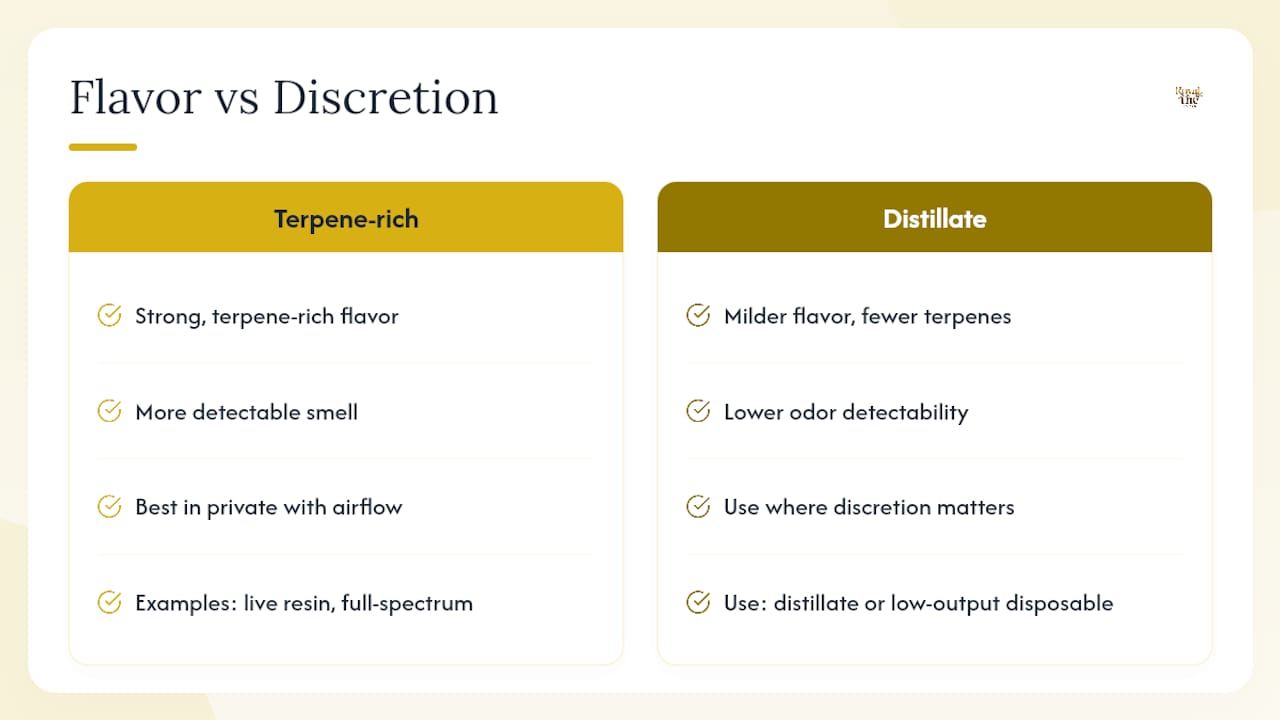
What I’d recommend: if you’re in a setting where discretion matters, reach for a distillate cart or a low-output disposable and exhale toward ventilation. Save the full-spectrum and live resin options for situations where you have privacy and airflow. The flavor difference is real, but so is the odor difference. Picking the right product for the context is more practical than trying to mask a terpene-rich cart with a sploof and hoping for the best.
Sources
- Do Weed Vape Pens Smell? Cannabis Vaping Odor Guide
- Learn How to Hide Vape Smoke with Simple Tricks — SOK VAPE
- Do Vape Carts Smell on Clothes? – LOOKAH Online
