


THC gummies typically produce effects for 4–8 hours, with onset starting 30–120 minutes after you eat one and the edible peak time landing around 2–3 hours in. Separately, an unopened commercial gummy stays potent and safe to eat for roughly 6–12 months when stored properly.
Those are two very different clocks, and mixing them up is where most confusion starts.
- Effect timeline: Onset 30–120 min → peak 2–3 hours → total duration 4–8 hours (up to ~12 hours at high doses or low tolerance)
- Shelf life: Commercial gummies 6–12 months unopened, shorter once opened; homemade gummies 1–4 weeks refrigerated
The sections below cover the science behind those ranges, how dose changes the timeline, what wrecks potency in storage, and exactly what to do if you take too much.
Key Takeaways
THC gummies typically produce effects for 4–8 hours after a 30–120 minute onset, while commercial gummies stay potent for up to 6–12 months when stored sealed and cool.
| Point | Details |
|---|---|
| Effect duration | Onset 30–120 min, peak 2–3 hours, total 4–8 hours; up to ~12 hours at high doses. |
| Shelf life basics | Unopened commercial gummies last 6–12 months; opened packs and homemade gummies age faster. |
| Top storage tip | Airtight container, away from heat and light; refrigerator extends potency; freezing works but may change texture. |
| Dosing rule | Start at 2.5–5 mg THC; wait at least 2 hours before redosing to avoid stacking doses at peak. |
| Thcvapesuk | Carries lab-tested gummies with COA-verified potency so you know the exact dose before you eat one. |
Table of Contents
- How your body absorbs and processes a THC gummy
- How long do gummies last? Onset, peak, and total duration by dose
- Why the same gummy hits differently for different people
- Why gummies often feel stronger than smoking or vaping
- How long THC shows up on drug tests vs. how long you feel high
- How long gummies stay good: shelf life, storage, and spoilage signs
- Safe dosing rules and what to do if you take too much
- What the research actually shows about edible duration and shelf life
- The part most guides get wrong about edibles
- Lab-tested gummies: what to look for before you buy
- Sources
How your body absorbs and processes a THC gummy
Swallowing a gummy is nothing like taking a hit. When you inhale cannabis, THC reaches your bloodstream in seconds through the lungs. Eat it, and the molecule has a much longer road ahead.
The gummy dissolves in your stomach, THC passes through the intestinal wall, and the portal vein carries it straight to the liver before it ever reaches your brain. That stop at the liver is the key difference. Liver enzymes convert delta-9-THC into 11-hydroxy-THC (11-OH-THC), a metabolite that crosses the blood-brain barrier efficiently and tends to produce stronger, longer-lasting psychoactive effects than the original molecule.
The full path looks like this: ingest → stomach → small intestine → liver (conversion to 11-OH-THC) → bloodstream → brain and fat tissue → effects.
Fat tissue matters because cannabinoids are lipophilic, meaning they bind to fat. That storage and slow release from fat cells is part of why an edible high can linger hours after you feel like it should be over.
How long do gummies last? Onset, peak, and total duration by dose
Typical edible onset runs 30–120 minutes, peak hits around 2–3 hours after ingestion, and most people feel effects for 4–8 hours total. Higher doses or lower tolerance can push that to roughly 12 hours.
| Dose | Typical onset | Peak window | Likely total duration |
|---|---|---|---|
| 2.5–5 mg THC | 45–90 min | 2–3 hours | 3–5 hours |
| 10 mg THC | 30–90 min | 2–3 hours | 4–8 hours |
| 25–50 mg THC | 30–120 minutes | 2–4 hours | 6–12 hours |
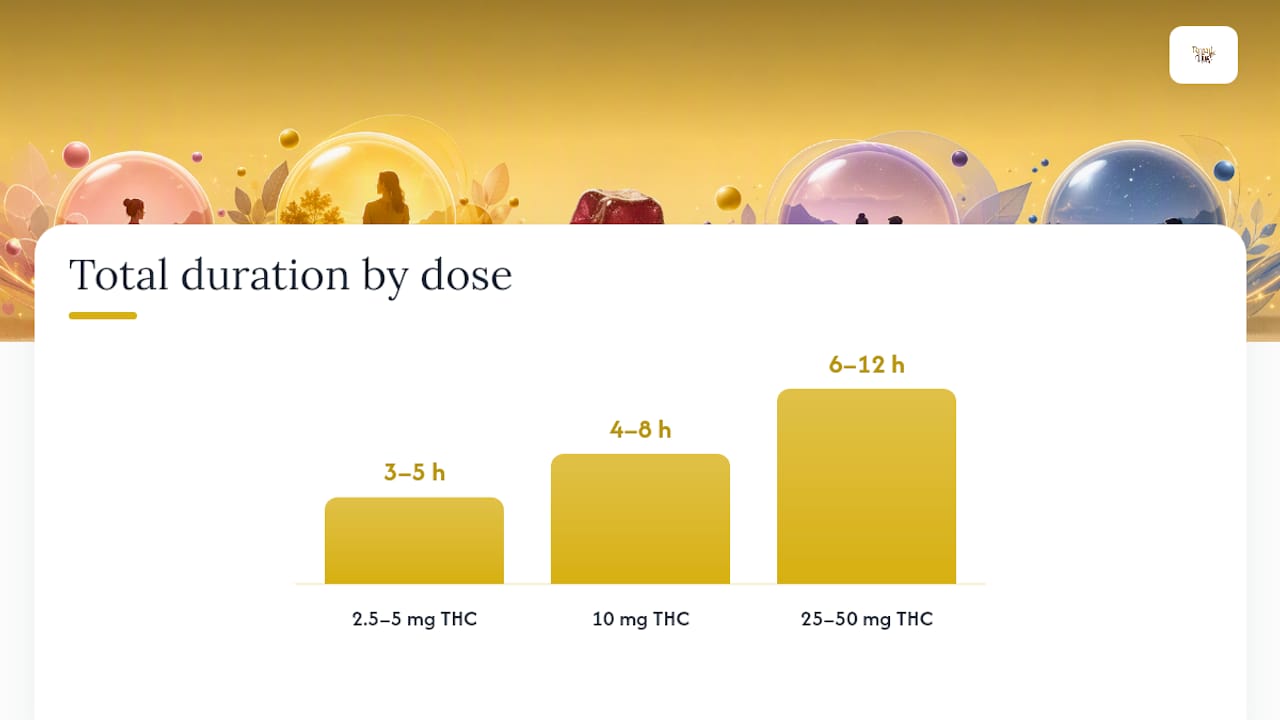
A first-time user who takes 5 mg might feel mild relaxation for three or four hours and barely notice a peak. Someone who takes 50 mg expecting a quick effect and gets impatient at the 90-minute mark is in a very different situation: the peak is still coming, and it will be intense.
Pro Tip: Wait at least 2 hours before considering a second dose. The most common overconsumption story starts with “I didn’t feel anything after an hour, so I took another one.”
The 10 mg dose printed on most commercial packaging is considered a standard single serving in legal U.S. markets, but it is not a beginner dose. If you have low tolerance or are new to edibles, 2.5–5 mg is a far safer starting point.
Why the same gummy hits differently for different people
Two people can eat identical gummies from the same package and have completely different experiences. Peer-reviewed pharmacokinetic reviews document large interindividual variability in how cannabinoids are absorbed and eliminated, and several factors drive that gap.
- Metabolism speed: Faster metabolizers process THC more quickly, shortening duration. Slower metabolizers may feel effects longer and at lower intensity per hour.
- Body fat percentage: THC accumulates in fat tissue. Higher body fat can mean a longer, slower release of cannabinoids back into the bloodstream after the initial peak.
- Tolerance: Regular cannabis users develop tolerance to THC’s psychoactive effects. A daily user may feel a 10 mg gummy for 3 hours; a first-timer may feel it for 6–8 hours.
- Dose: Larger doses extend duration, not just intensity. A 50 mg gummy does not just hit harder than a 5 mg one — it lasts considerably longer.
- Food in your stomach: Eating a gummy on an empty stomach speeds onset and can sharpen the peak. A full meal slows absorption and softens the curve.
- Age: Older adults often metabolize cannabinoids more slowly, which can extend both onset time and total duration.
- Medications: Some prescription drugs inhibit or induce the liver enzymes (particularly CYP3A4 and CYP2C9) that process THC. If you take prescription medications, consult a clinician before using THC edibles — interactions can meaningfully change both the intensity and duration of effects.
Why gummies often feel stronger than smoking or vaping
The short answer: 11-OH-THC and a slower onset that tricks you into taking more.
When you smoke or vape cannabis, delta-9-THC goes directly to your brain. The liver conversion step is minimal. With an edible, first-pass metabolism converts a significant portion of delta-9-THC into 11-OH-THC, which many researchers consider more potent at crossing the blood-brain barrier. The result is an effect profile that feels heavier, more body-focused, and longer-lasting than an equivalent inhaled dose.
The behavioral trap compounds this. Because onset is slow, people who are used to the near-instant feedback of vaping often assume the gummy isn’t working. They take a second piece. Then the first dose peaks, the second dose starts arriving, and the combined effect is far beyond what they intended. This is not a rare edge case — it is the most common reason people end up uncomfortably high from edibles.
For a direct comparison of how the delivery route changes the experience, the vaping vs. smoking guide covers the pharmacology in more detail.
How long THC shows up on drug tests vs. how long you feel high
Feeling high and testing positive are two completely separate timelines. The subjective high from a gummy ends within hours. THC metabolites, however, stay detectable in your body long after any psychoactive effect is gone.
- Saliva: Up to ~72 hours for occasional users; potentially longer with regular use
- Blood: Hours to 1–2 days for occasional users; up to several days for regular users
- Urine: 1–3 days for occasional users; up to 30 or more days for daily users
- Hair: Up to approximately 90 days regardless of use frequency
These ranges come from reported detection windows across clinical and consumer sources and vary based on dose, frequency of use, metabolism, and the sensitivity of the specific test used. Employer and legal drug-testing policies differ widely, and some use cutoff thresholds that shorten or extend these windows in practice. If you face a drug test for employment or legal reasons, do not rely on general ranges — consult the testing policy directly or speak with a qualified professional.
How long gummies stay good: shelf life, storage, and spoilage signs
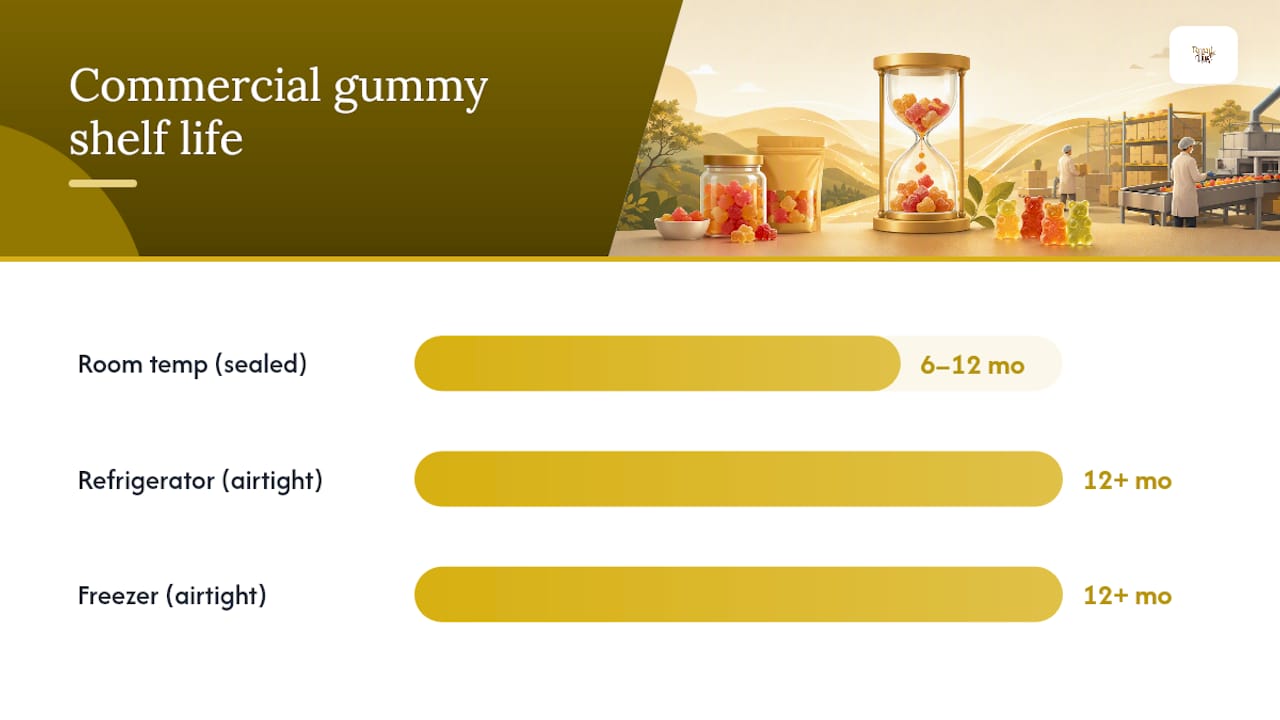
Commercial gummies typically retain potency and quality for about 6–12 months when stored cool and sealed. Gummies are actually the most shelf-stable common edible format because their low water activity and preservatives inhibit microbial growth. Baked goods spoil in days or weeks by comparison.
| Storage method | Commercial gummies | Homemade gummies |
|---|---|---|
| Room temperature (sealed, dark) | 6–12 months | 1–2 weeks |
| Refrigerator (airtight container) | Up to 12+ months | 3–4 weeks |
| Freezer (airtight, wrapped) | 12+ months (texture may change) | Up to 3 months (texture may change) |
Heat, light, oxygen, and humidity all accelerate THC degradation, converting it into CBN and other less psychoactive compounds. A gummy left in a hot car or a sunny windowsill for a few weeks can lose a meaningful portion of its potency even if it looks and tastes fine.
Signs to discard a gummy:
- Visible mold (any color, any amount)
- Sour or off smell that wasn’t there when you opened the package
- Slimy or unusually wet texture
- Major hardening or crystallization that suggests moisture exposure
Expiration dates on gummy packaging refer primarily to quality — texture, flavor, and mold risk — rather than immediate safety. A gummy past its best-by date is not automatically dangerous, but mold or off-odors are genuine discard signals regardless of the date printed on the label.
Practical storage tips: Keep gummies in an airtight container, away from direct light and heat. A small food-safe desiccant packet inside the container helps control humidity. Freezing preserves potency well but can make gummies sticky or change their texture when thawed — wrap them individually if you freeze a large batch.
Safe dosing rules and what to do if you take too much
NIDA and other public-health sources consistently emphasize conservative dosing and awareness of delayed onset as the two most important safety principles for edibles.
Dosing starting points:
- Beginners: 2.5–5 mg THC
- Occasional users: 5–10 mg THC
- Experienced users: 10–25 mg THC
- High-dose territory: 25–50 mg+ (not recommended without established tolerance)
Wait at least 2 hours before redosing. For a detailed breakdown of dose bands and what to expect at each level, the THC gummy dosage guide covers beginner-to-advanced ranges with practical examples.
If you’ve taken too much, follow these steps:
- Stay calm. An uncomfortable edible experience is temporary. Remind yourself it will pass.
- Sit or lie down somewhere safe and comfortable.
- Hydrate with water or a non-caffeinated drink.
- Distract yourself — a familiar show, music, or a calm conversation with someone you trust.
- Avoid alcohol and sedatives. Mixing THC with either significantly amplifies impairment.
- Call a sober friend if you feel panicked or need reassurance.
- Call Poison Control (1-800-222-1222) if symptoms are severe — extreme confusion, chest pain, difficulty breathing, or vomiting.
- Call 911 if someone is unresponsive, having a seizure, or showing signs of a medical emergency.
Mixing THC gummies with alcohol, benzodiazepines, or opioids can intensify sedation and impairment unpredictably. If you take prescription medications, speak with a clinician before using THC edibles.
This article provides general information, not medical advice. Consult a qualified healthcare professional for guidance specific to your situation.
What the research actually shows about edible duration and shelf life
The evidence base for edible pharmacokinetics is solid in its broad strokes but noisy in the details. A few key points from primary sources:
- Pharmacokinetic reviews on NCBI confirm that oral THC produces 11-OH-THC via first-pass metabolism, and that this metabolite contributes to the stronger, longer-lasting effects characteristic of edibles compared with inhaled cannabis.
- Peer-reviewed cannabinoid pharmacology reviews document large interindividual variability in absorption and elimination, which is why onset and duration ranges are wide rather than precise single numbers.
- NIDA’s cannabis research summaries emphasize variability of effects, the importance of conservative dosing, and awareness of health risks — particularly for people with underlying conditions or those on medications.
- Food-science and storage research supports the principle that airtight, cool, dark storage preserves both gummy quality and cannabinoid potency, with freezing offering the longest preservation window.
One honest limitation: most clinical pharmacokinetic studies use controlled oral THC doses in laboratory settings, not commercial gummies with variable formulations. Real-world products vary in how well they emulsify THC into the gummy matrix, which affects absorption rate and bioavailability. Homemade gummies, in particular, can have uneven THC distribution throughout the batch.
The part most guides get wrong about edibles
Most edible guides spend their energy on onset time and then move on. The more useful thing to understand is that the peak is where most people get into trouble, not the onset.
You can feel an edible starting to work and still be 45 minutes away from the actual peak. That gap is where accidental overconsumption happens. Someone feels the first wave, decides the dose is manageable, takes another piece, and then both doses peak simultaneously. The onset is just the opening act.
The other thing guides understate: the difference between feeling high and being impaired is not as clean as people assume. At the tail end of a long edible experience, you may feel mostly sober while your reaction time and judgment are still meaningfully affected. This matters for driving, operating machinery, or making decisions you’d rather not revisit the next morning.
Storage advice also tends to be vague. “Keep in a cool, dark place” is technically correct but undersells how much heat specifically damages THC. A gummy stored at room temperature in a warm kitchen loses potency faster than one kept in the refrigerator, even though both are sealed and away from direct light. If you paid for a lab-tested product with a specific potency, the refrigerator is worth the extra step.
Lab-tested gummies: what to look for before you buy
Knowing how long a gummy lasts matters a lot less if you don’t know what’s actually in it. A lab-tested gummy comes with a certificate of analysis (COA) that confirms potency (how many milligrams of THC per piece), a terpene profile, and contaminant screening for pesticides, heavy metals, and residual solvents. That COA is what makes dosing predictable rather than a guess.

Thcvapesuk carries a curated range of lab-tested THC gummies with clear potency labeling, so you know exactly what you’re working with before the first bite. If you want to compare options by potency and effect profile before choosing, the THC gummies buying guide walks through how to match a gummy to your tolerance and goals. Browse the full gummy category at Thcvapesuk and check the COA before you order.
Sources
The claims in this article draw on public-health agencies, peer-reviewed pharmacokinetic reviews, and food-science storage guides. For medical or clinical questions, prefer peer-reviewed sources over consumer sites.
- How to Store Edibles: Shelf Life and Potency Preservation | RethinkTHC
- Do edibles go bad? — Weedmaps
- Pharmacokinetics and metabolism of cannabinoids — NCBI / PMC5010515
- How Long Do Gummies Last? Shelf Life and Storage Tips | Hyperwolf
- Cannabinoid pharmacology review — NCBI / PMC5260817
- Cannabis (marijuana) — research topics | NIDA
This article is general information, not a substitute for advice from a qualified doctor. Consult a qualified healthcare professional about your own circumstances before acting on anything here.
