

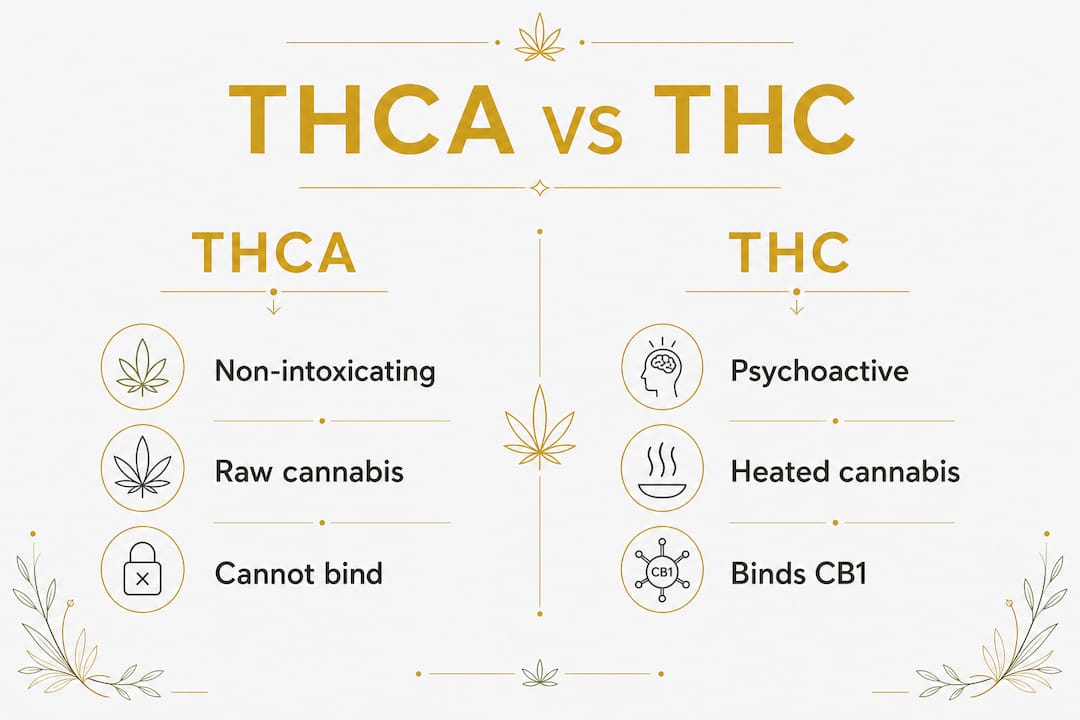
THCA (tetrahydrocannabinolic acid) is the raw, non-intoxicating cannabinoid found in living cannabis plants that converts into psychoactive THC when exposed to heat. The difference between THCA and THC is not a matter of potency or strain. It is a matter of chemistry. Understanding the thca vs thc distinction tells you exactly what a product will do to you before you consume it, and whether it is legal where you live. This guide covers the science, the effects, the legal status, and the practical consumption choices you need to make informed decisions.
What is the difference between THCA and THC?
THCA is the acidic precursor to THC. Raw cannabis plants produce THCA, not THC. The plant synthesizes THCA as part of its natural chemistry, and THC only appears in meaningful quantities after heat is applied.
The key structural difference is a carboxyl group attached to the THCA molecule. That extra molecular group prevents THCA from binding effectively to the CB1 receptors in your brain. CB1 receptor binding is what produces the psychoactive high. Without that binding, THCA produces no intoxication.
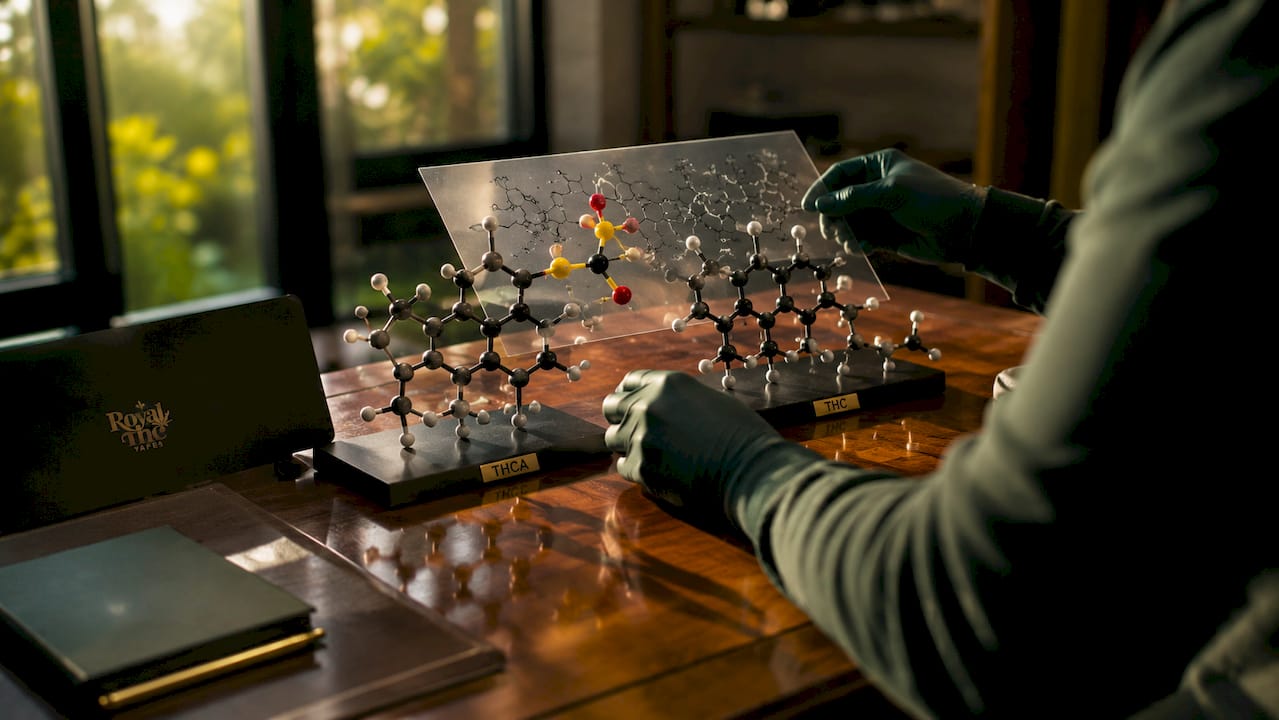
THC, by contrast, binds strongly to CB1 receptors and causes the euphoria, mood alteration, and cognitive effects cannabis is known for. Effects from smoking or vaping typically begin within minutes and last 2–4 hours. THCA in its raw form produces none of those effects.
How does decarboxylation convert THCA into THC?
Decarboxylation is the chemical process that removes the carboxyl group from THCA and produces THC. Heat drives this reaction. The process happens automatically when you smoke, vape, or cook cannabis above approximately 220°F.
Here is what happens step by step:
- Raw cannabis contains THCA. Fresh flower, unheated concentrates, and raw tinctures all contain THCA as the dominant cannabinoid.
- Heat removes the carboxyl group. At around 220°F, the carboxyl group breaks off as carbon dioxide and water vapor.
- THC forms. The remaining molecule is delta-9 THC, which binds to CB1 receptors and produces psychoactive effects.
- Mass is lost in the process. Because the carboxyl group leaves the molecule, THCA loses 12.3% of its mass during conversion. This is why 100 mg of THCA yields approximately 87.7 mg of THC.
- Conversion is not always complete. Incomplete decarboxylation, from low temperatures or short cooking times, leaves some THCA unconverted.
This conversion ratio matters enormously for dosing. Lab testing reports calculate total THC using the formula: Total THC = (THCA × 0.877) + THC. A product labeled 30% THCA yields approximately 26.3% THC after heating. Consumers who ignore this calculation consistently overestimate or underestimate their dose.
Pro Tip: When reading a certificate of analysis (COA) for any cannabis product, always apply the 0.877 conversion factor to the THCA percentage before estimating your actual THC intake. The raw THCA number on the label is not your effective THC dose.
For edibles, decarboxylation must happen before infusion. Baking raw flower directly into butter without a prior decarboxylation step at 220–240°F for 30–45 minutes produces a much weaker product than intended.
What are the effects and benefits of THCA compared to THC?
THCA is pharmacologically active even though it does not intoxicate you. Research shows it interacts with PPARγ receptors, which are involved in inflammation and neuroprotection. THCA demonstrates anti-inflammatory and neuroprotective potential in cell and animal studies, though human clinical trials have not yet confirmed these effects at scale.
THC produces a well-documented set of effects through CB1 receptor activation:
- Euphoria and mood elevation from direct CB1 binding in the limbic system
- Pain relief through modulation of pain signaling pathways
- Appetite stimulation, commonly called the munchies
- Short-term memory impairment at higher doses
- Anxiety or paranoia in sensitive individuals or at high doses
THCA’s effects profile looks very different:
- No intoxication at any dose when consumed raw
- Potential anti-inflammatory effects based on early research
- No cognitive impairment, making it suitable for daytime use without functional disruption
- Variable bioavailability when consumed raw, since the digestive system does not convert THCA to THC efficiently
“THCA is not a milder version of the THC high. It is a chemically distinct molecule with its own pharmacological activity. Consumers who expect a subtle buzz from raw THCA will not get one. What they may get, based on emerging research, is meaningful anti-inflammatory support without any impairment.”
The onset and duration differences are also significant. THC from smoking or vaping hits within minutes and lasts 2–4 hours. Raw THCA consumed through juicing or unheated tinctures produces no high at any point, regardless of dose.
How does legal status differ between THCA and THC?
The legal picture for THCA is genuinely complicated, and getting it wrong carries real consequences.
Under the 2018 US Farm Bill, a cannabis plant qualifies as legal hemp if its delta-9 THC content is 0.3% or less by dry weight. The original law did not include THCA in that calculation. This created a significant loophole. High-THCA hemp flower with 25% THCA but low delta-9 THC passed legal testing as hemp, even though heating it produces a fully intoxicating product.
| Category | THCA | THC |
|---|---|---|
| Legal status (pre-2026 US) | Legal as hemp if delta-9 THC ≤ 0.3% | Federally controlled (Schedule I) |
| Psychoactive when raw | No | Yes |
| Psychoactive when heated | Yes (converts to THC) | Yes |
| 2026 NDAA rule | Total THC including THCA ≤ 0.3% | No change |
| UK legal status | Controlled under Misuse of Drugs Act | Controlled under Misuse of Drugs Act |
The National Defense Authorization Act (NDAA) for 2026 closes this loophole. The new federal rule redefines hemp to include total THC, incorporating THCA in the calculation. Smokable high-THCA hemp products that were legal in 2024 are now subject to much stricter limits.
For consumers in the UK, both THCA and THC are controlled substances under the Misuse of Drugs Act 1971. Neither is legally available for recreational use. THCA does not benefit from any hemp loophole under UK law. Consumers here should be aware that products marketed as “legal THCA” in the US do not carry the same status in the UK.
The practical risk for consumers is real. A product sold legally as high-THCA hemp in a US state can trigger a positive drug test after consumption, because the body converts some THCA to THC during digestion. Assuming a product is “non-psychoactive” based on its label alone is a mistake.
What are the best ways to consume THCA and THC?
Your consumption method determines whether you get THCA’s non-intoxicating effects or THC’s psychoactive ones. The choice is entirely in how you prepare and consume the product.
Methods that preserve THCA (no intoxication):
- Juicing raw cannabis leaves or fresh flower delivers THCA directly without any conversion. This is the most reliable way to consume THCA therapeutically.
- Unheated tinctures made with raw cannabis and a cold-extraction process retain THCA. Check that the product specifies no heat was used.
- Raw capsules containing undecarboxylated cannabis powder deliver THCA orally.
Methods that convert THCA to THC (intoxicating):
- Smoking converts THCA instantly through combustion. The conversion happens immediately, and effects begin within minutes.
- Vaping applies controlled heat that decarboxylates THCA efficiently. A quality THC disposable vape delivers consistent, measurable THC effects with each draw.
- Dabbing uses high heat and produces near-complete conversion of THCA concentrates to THC.
- Edibles require a decarboxylation step before infusion. Without it, the product delivers THCA, not THC.
The drug test risk deserves special attention. Even raw THCA consumed orally can partially convert to THC through stomach acid and metabolic processes. Consumers who need to pass drug screenings should treat any cannabis product, regardless of its THCA or THC label, as a potential positive test result.
For consumers who want reliable, predictable THC effects, vaping is the most consistent delivery method. Products from lab-tested THC carts provide verified potency, so the conversion math is already done for you. You know exactly what you are getting per draw.
Key takeaways
THCA is the non-intoxicating precursor to THC, and heat is the only thing that separates them. Every consumption choice you make determines which molecule you actually experience.
| Point | Details |
|---|---|
| THCA does not intoxicate raw | Raw THCA cannot bind CB1 receptors, so it produces no psychoactive high. |
| Heat triggers conversion | Temperatures above 220°F convert THCA to THC via decarboxylation. |
| Apply the 0.877 factor | Multiply THCA percentage by 0.877 to calculate actual THC yield after heating. |
| Legal status varies by region | In the UK, both THCA and THC are controlled substances with no hemp loophole. |
| Vaping delivers consistent THC | Vaping converts THCA to THC reliably, giving predictable onset and duration. |
Why most consumers are still getting this wrong
The biggest misconception I see is that people treat THCA as a “legal high” or a gentler version of THC. It is neither. THCA is a completely different molecule that happens to become THC the moment you apply heat. That distinction sounds technical, but it has real consequences for dosing, legality, and expectations.
The THCA market in the US grew rapidly because of the Farm Bill loophole, and a lot of products entered the market with labels that were technically accurate but practically misleading. A flower labeled “25% THCA” is not a non-psychoactive wellness product. It is a product that becomes highly intoxicating the moment you light it. Consumers who did not understand the chemistry were getting much stronger effects than they expected.
What I find genuinely interesting is the therapeutic potential of true raw THCA. The PPARγ receptor research is early, but it points toward real anti-inflammatory applications that do not require intoxication. That is a meaningful distinction for people who want the plant’s benefits without cognitive impairment. The problem is that the market has not caught up with clean, standardized raw THCA products. Most of what is sold as “THCA” is intended to be smoked.
My advice is straightforward. Read the COA. Apply the 0.877 factor. Know your local law. And choose your consumption method deliberately, because that choice determines everything about what you actually experience.
— Jsuis
Premium THC vapes for consistent, lab-verified effects
Knowing the chemistry behind THCA and THC is only useful if the product you buy actually delivers what the label says. Thcvapesuk stocks a curated range of premium THC vape products that are rigorously lab-tested, so the potency on the label reflects what you actually inhale.
Whether you prefer cartridges, disposables, or infused gummies, every product goes through third-party testing before it ships. Brands like Stiiizy are available in multiple strains and potency levels, giving you real control over your experience. Check the current specials for the latest offers on top-rated vapes and edibles, all shipped discreetly across the UK.
FAQ
Does THCA get you high?
THCA does not produce a high when consumed raw because its molecular structure prevents CB1 receptor binding. Heating THCA converts it to THC, which does cause intoxication.
What is THCA, exactly?
THCA is tetrahydrocannabinolic acid, the acidic cannabinoid produced naturally in raw cannabis plants before any heat is applied. It is the direct chemical precursor to delta-9 THC.
Is THCA legal in the UK?
THCA is a controlled substance in the UK under the Misuse of Drugs Act 1971. The hemp loophole that existed in US law does not apply in the UK, so THCA products are not legally available for recreational use.
How much THC does THCA convert to?
100 mg of THCA yields approximately 87.7 mg of THC after full decarboxylation. A product labeled 30% THCA produces roughly 26.3% THC when heated.
Will THCA show up on a drug test?
Yes. Even raw THCA can partially convert to THC through metabolic processes in the body, which means it can trigger a positive result on standard drug screenings.
